


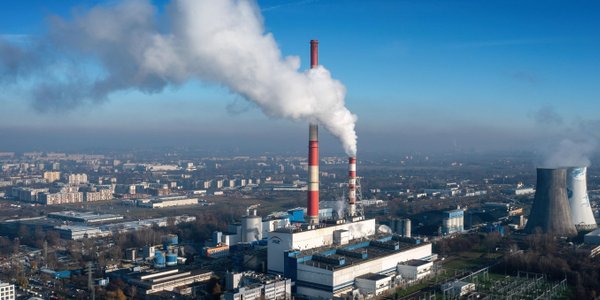
Poland's High ETS Costs Undermine Industry Despite Emission Reductions
Translated from Polish, summarized and contextualized by DistantNews.
At a glance
Analysis
Named sources
Context piece
- Poland faces high costs from the EU's Emissions Trading System (ETS) due to its historical reliance on coal-fired power generation.
- While ETS reduces emissions, the high CO2 price negatively impacts energy costs, industrial competitiveness, and household expenses.
- Instead of adapting, some Polish companies have resorted to importing goods, harming domestic production.
Poland's participation in the European Union's Emissions Trading System (ETS) imposes a particularly high cost on the country, largely due to its historical dependence on coal for energy production. The price of CO2 emissions significantly affects the cost of generating electricity and the competitiveness of Polish industry.
The price of CO2 emissions very strongly affects the costs of energy generation and the competitiveness of Polish industry.
Dr. Piotr Arak, an expert, acknowledges that the ETS mechanism is effective in reducing emissions in covered sectors. However, he emphasizes that the current high CO2 price acts not only as a driver for transformation but also as a substantial present-day cost for the energy sector, industry, and households.
Arak argues that the ETS should be evaluated not solely on the tonnage of CO2 reductions achieved but also on the economic cost of these reductions. By this measure, the system's performance is less favorable for Poland.
We should assess the ETS not only through the prism of tons of CO2 that disappear, but also through the cost of this reduction for the economy.
He points out that rather than adapting to the system, some companies have opted to import goods from countries like Belarus, Ukraine, Turkey, and China. This practice, he contends, ultimately harms domestic industrial production, suggesting a need for a more balanced approach to emissions reduction that considers economic impacts.
Instead of adapting, companies have started importing from Belarus, Ukraine, Turkey, or China. As a result, domestic industrial production suffers.
DistantNews Editorial
Originally published by Rzeczpospolita in Polish. Translated, summarized, and contextualized by our editorial team with added local perspective. Read our editorial standards.
More Stories


From Our Blog

What Gets Lost (and Found) When News Is Translated

The Critical Role of Diaspora Media in Global News

What Travellers Should Know About Countries with Restricted Press

A Digital Nomad's Guide to Following Local News

How the Same Story Looks Different in Different Countries
