


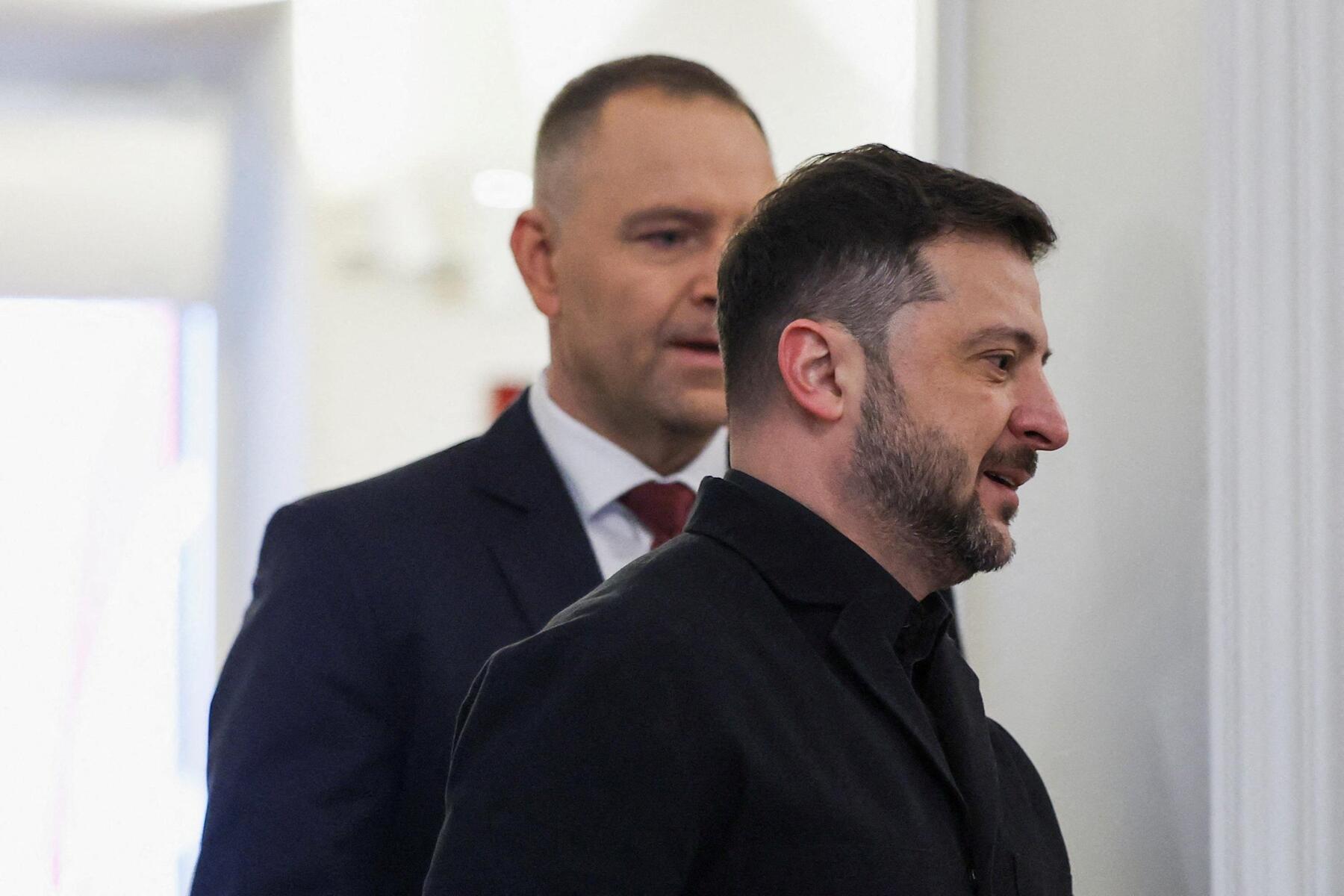
Poland's President revokes country's highest award from Zelenskyy amid historical dispute
Translated from German, summarized and contextualized by DistantNews.
At a glance
News
From a news agency
New plan
- Poland's President Andrzej Duda has revoked the country's highest honor, the Order of the White Eagle, from Ukrainian President Volodymyr Zelenskyy.
- The decision stems from a dispute over historical events, specifically the actions of the Ukrainian Insurgent Army (UPA) during World War II.
- Ukraine's government condemned the move as a "strategic mistake" and "disrespectful," despite Poland's significant support in Ukraine's defense against Russia.
Polish President Andrzej Duda has withdrawn the Order of the White Eagle, Poland's highest state decoration, from Ukrainian President Volodymyr Zelenskyy. The decision, announced Friday evening in a video message, follows a dispute concerning historical interpretations of World War II.
The Ukrainian government swiftly denounced the move, labeling it a "strategic mistake" and "disrespectful." This action comes at a time when Poland has been one of Ukraine's most crucial military and humanitarian allies in its defense against Russia.
The diplomatic rift was triggered in late May when Zelenskyy named a Ukrainian army unit after the Ukrainian Insurgent Army (UPA). This organization was responsible for massacres of Poles in Volhynia during World War II. Between 1943 and 1945, UPA members are estimated to have killed up to 100,000 ethnic Poles in the Volhynia region, which was part of Poland until 1939.
The UPA operated as the military wing of the Organization of Ukrainian Nationalists (OUN) in the 1940s. During World War II, elements of the OUN and UPA collaborated with Nazi Germany in their fight for Ukrainian independence from the Soviet Union. Today, members of the OUN and UPA are revered as heroes in Ukraine.
Disagreements over the Volhynia massacre had already caused diplomatic friction between Kyiv and Warsaw in 2024, highlighting the sensitive nature of historical memory in bilateral relations.
DistantNews Editorial
Originally published by Die Presse in German. Translated, summarized, and contextualized by our editorial team with added local perspective. Read our editorial standards.
More Stories


From Our Blog

What Gets Lost (and Found) When News Is Translated

The Critical Role of Diaspora Media in Global News

What Travellers Should Know About Countries with Restricted Press

A Digital Nomad's Guide to Following Local News

How the Same Story Looks Different in Different Countries
