


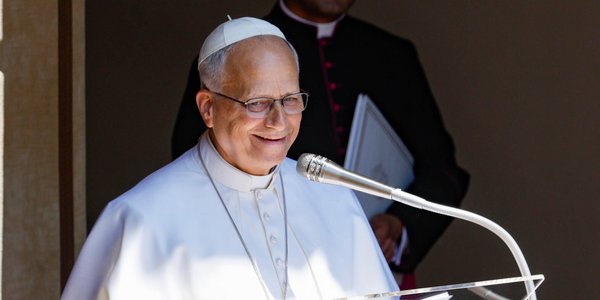
Pope Leo XIV's Encyclical 'Magnifica Humanitas' Explores Humanity's Role in the AI Era
Translated from Polish, summarized and contextualized by DistantNews.
At a glance
Analysis
Named sources
Context piece
- Pope Leo XIV's new encyclical, "Magnifica Humanitas," focuses on humanity's place in the age of artificial intelligence, emphasizing human dignity over technological advancement.
- The encyclical builds on the principles of "Rerum Novarum," extending the concept of common goods to include intangible and cultural assets like patents, algorithms, and data.
- It advocates for truth as a common good, urging support for credible journalism and thoughtful debate spaces that prioritize argumentation and verification over immediate reactions.
Pope Leo XIV's latest encyclical, "Magnifica Humanitas," addresses the profound impact of artificial intelligence on humanity, asserting that human dignity remains paramount. Contrary to some reports, the encyclical does not focus on AI itself but rather on the human condition within this rapidly evolving technological era. This approach echoes Pope Leo XIII's 1891 encyclical "Rerum Novarum," which, while addressing the industrial revolution's societal shifts, centered on the "new things" of the age.
The real theme of the encyclical 'Magnifica Humanitas' is man, his situation in the age of artificial intelligence. The title clearly indicates the author's intention. Artificial intelligence can inspire admiration or a sense of threat, but humanity is invariably magnificent.
"Rerum Novarum" strongly defended private property while cautioning against the misuse of wealth, establishing the principle of the universal destination of earthly goods. Pope Leo XIV expands this concept in "Magnifica Humanitas," arguing that the common good now encompasses not only material resources but also intangible and cultural assets. This includes intellectual property like patents, algorithms, digital platforms, technological infrastructure, and crucially, data, recognizing that knowledge and technology are the new drivers of wealth.
The principle of the universal destination of the goods of the earth – soil, water, air, natural resources – is one of the foundations of the social teaching of the Church. Leo XIV goes a step further.
The encyclical places particular emphasis on truth as a fundamental common good. It calls for the promotion of reliable journalism and the creation of public forums where reasoned arguments and verified information take precedence over instant responses. Pope Leo XIV highlights the diminishing space for these essential elements in today's information landscape, especially within the media market.
The universal destination – we read in the encyclical – covers not only material goods, but also intangible and cultural goods. These are new forms of ownership: patents, algorithms, digital platforms, technological infrastructure and data. Knowledge and technology determine wealth today.
Drawing parallels with historical defenses of free speech, the article references John Milton's 1644 assertion that truth will prevail in an open contest with falsehood. However, it cautions that this holds true only if the contest is both open and equal. In the current era, particularly with the rise of AI, achieving such equality is increasingly difficult. The encyclical warns that AI creates fertile ground for the proliferation of "post-truth," which not only challenges the significance of facts but also undermines the necessity of responsible engagement with information.
Truth is also – and perhaps above all – a common good. This is not about theoretical considerations, but very concrete postulates concerning what the Pope calls the ecology of communication.
DistantNews Editorial
Originally published by Rzeczpospolita in Polish. Translated, summarized, and contextualized by our editorial team with added local perspective. Read our editorial standards.
More Stories



From Our Blog

What Gets Lost (and Found) When News Is Translated

The Critical Role of Diaspora Media in Global News

What Travellers Should Know About Countries with Restricted Press

A Digital Nomad's Guide to Following Local News

How the Same Story Looks Different in Different Countries
