


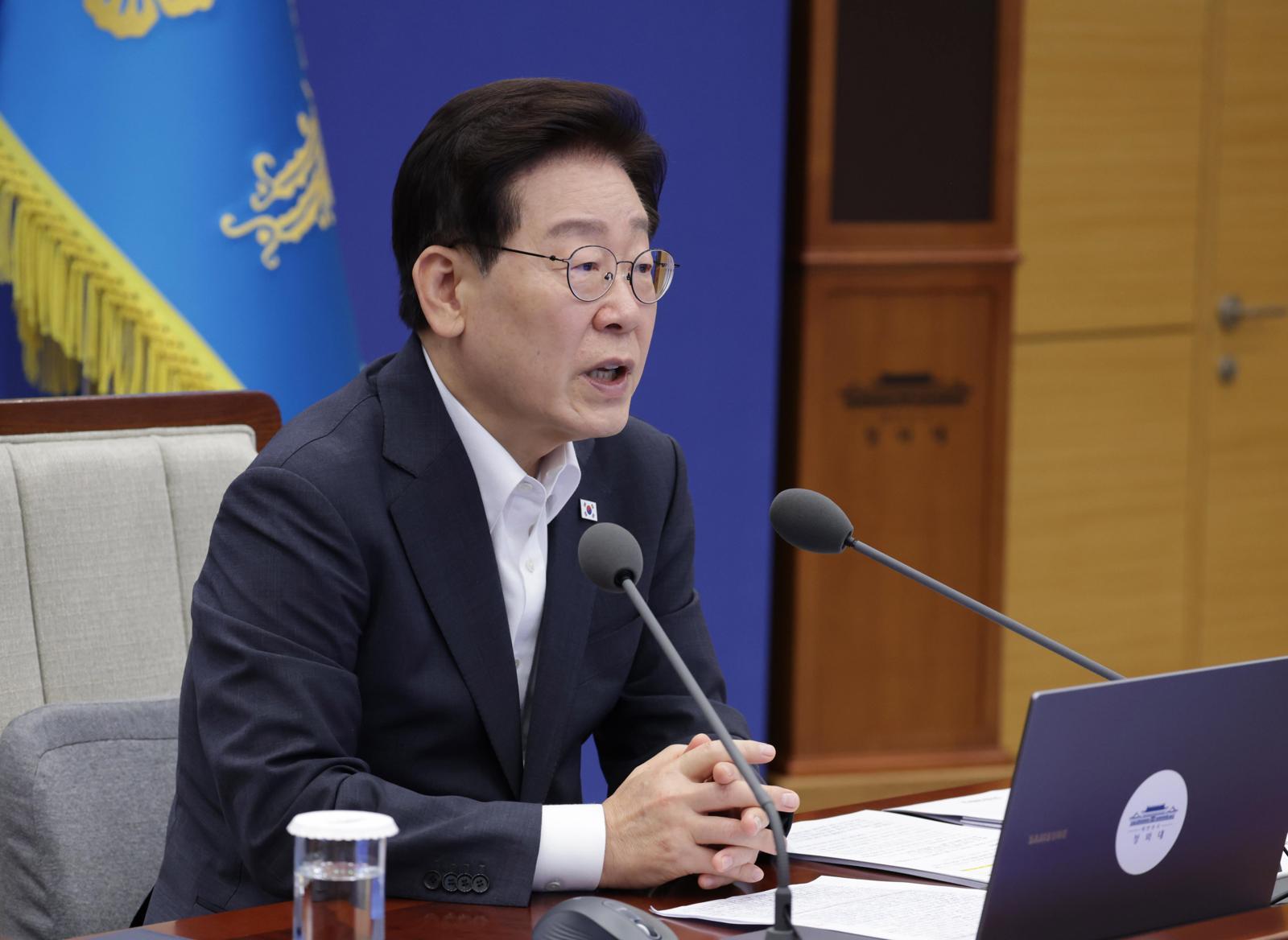
President Lee calls for 'all-out offensive' on housing supply
Translated from Korean, summarized and contextualized by DistantNews.
At a glance
News
Named sources
New plan
- South Korean President Lee Jae-myung emphasized the need for a comprehensive supply offensive to stabilize the real estate market and enable citizens to achieve homeownership.
- He identified the real estate issue as a core problem significantly impacting Korean society, exacerbating polarization and inequality due to excessive capital concentration.
- The president called for bold policy adjustments, including streamlining permits and securing land, and stressed that policy changes based on public input are a sign of effective governance, not inconsistency.
South Korean President Lee Jae-myung has called for a full-scale, multi-pronged offensive to tackle the nation's real estate crisis, aiming to ensure citizens can achieve the dream of homeownership. Speaking at a presidential senior staff meeting on August 13, 2026, Lee described real estate as a fundamental issue deeply affecting nearly all aspects of Korean society.
The government will concentrate its best efforts to ensure that citizens can enjoy a more stable living environment and achieve the dream of owning a home.
President Lee warned that the prolonged, excessive concentration of capital in the real estate sector has intensified polarization and inequality. He stated that the property bubble has reached an unsustainable level, noting that South Korean real estate prices are among the highest globally. He cautioned that continuing this trend could lead to a "lost 20 or 30 years" for the nation, likening the unresolved real estate problem to a ticking time bomb that threatens citizens' lives and the country's future.
Real estate is a core problem in Korea that profoundly affects almost all parts of our society.
To address this, Lee stressed the necessity of a coordinated approach involving supply, tax, and financial policies. He specifically highlighted the critical issue of housing supply, pointing to a "supply cliff" since 2022 due to reduced permits and construction starts. He urged for extraordinary efforts to overcome this shortage, including drastically shortening approval processes and revising laws if necessary to secure land for development.
The excessive concentration of social resources in real estate for a long time has deepened polarization and inequality, and the real estate bubble can no longer be left unattended.
Furthermore, President Lee encouraged a more flexible approach to policymaking. He criticized the outdated notion that changing a policy signifies inconsistency, stating that public officials should not fear revising plans based on public and political input. He emphasized that incorporating constructive suggestions and engaging in transparent discussions to create better, more complete policies is a normal and effective decision-making process. He also urged officials to move beyond administrative convenience and adopt a citizen-centric perspective, continuously improving policies to eliminate perceived unfairness, such as the "marriage penalty" in housing benefits.
We must invest all available means and capabilities into solving the real estate problem, which is like a time bomb threatening the lives of our people and the future of our nation.
DistantNews Editorial
Originally published by Dong-A Ilbo in Korean. Translated, summarized, and contextualized by our editorial team with added local perspective. Read our editorial standards.
More Stories


From Our Blog

What Gets Lost (and Found) When News Is Translated

The Critical Role of Diaspora Media in Global News

What Travellers Should Know About Countries with Restricted Press

A Digital Nomad's Guide to Following Local News

How the Same Story Looks Different in Different Countries
