


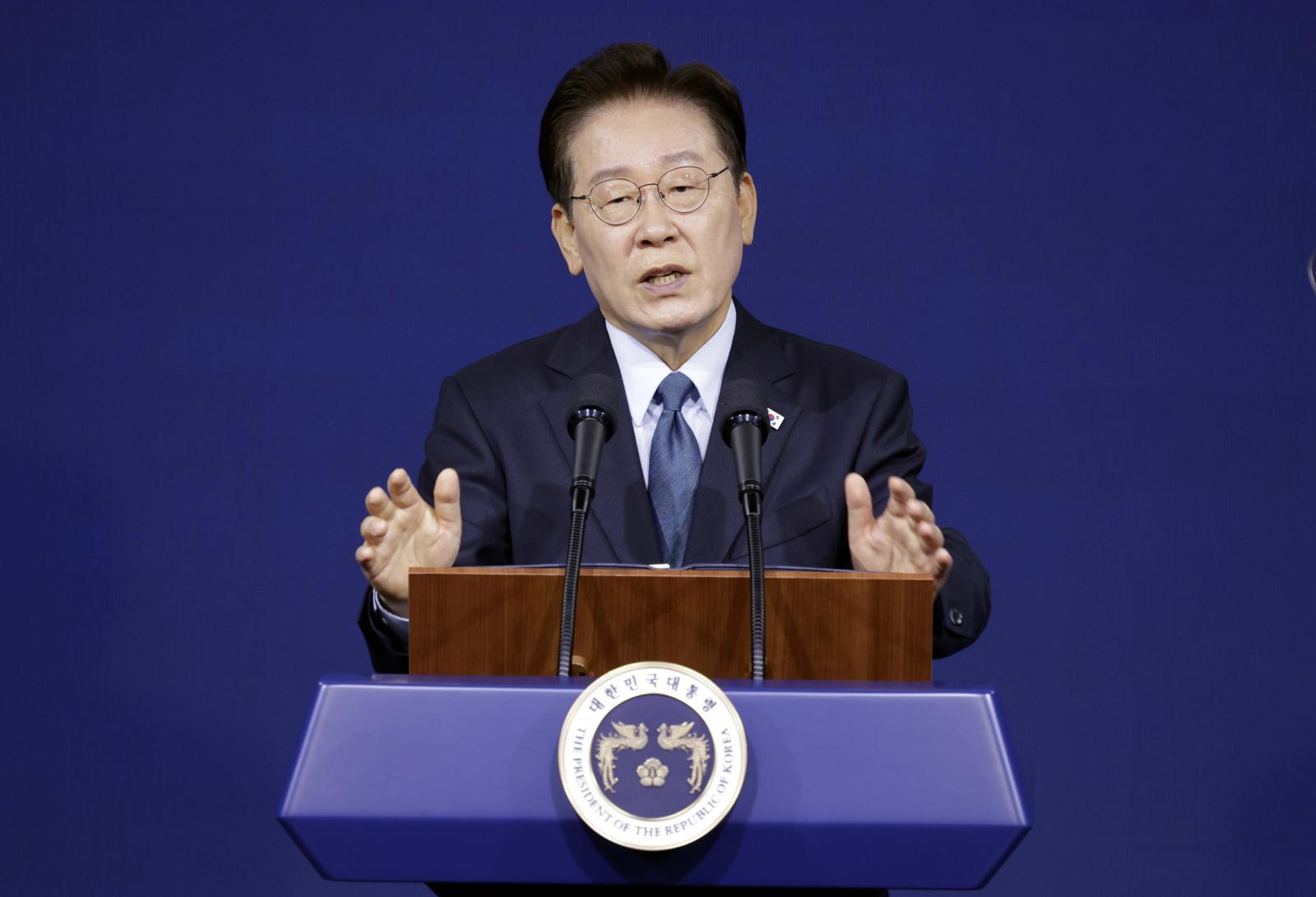
President Lee: Pressuring companies to relocate is 'outdated'
Translated from Korean, summarized and contextualized by DistantNews.
At a glance
News
Sources not specified
Context piece
- President Lee Jae-myung criticized the idea of pressuring companies to relocate, calling such thinking "outdated."
- He stated that companies choose locations based on efficiency, not coercion, and that forcing them would hinder global investment.
- The president emphasized the need for regions to attract investment by preparing infrastructure and offering incentives, rather than demanding it.
President Lee Jae-myung has strongly criticized the notion of pressuring companies to relocate their investments, labeling such approaches as "outdated." Speaking at a national report on advanced industrial development in Chungcheong on July 2, 2026, he argued that businesses make decisions based on efficiency and optimal conditions, not under duress.
In this day and age, where do companies move just because you put pressure on them? The idea that you can forcibly do this is outdated.
"In this day and age, where do companies move just because you put pressure on them? The idea that you can forcibly do this is outdated," President Lee stated, responding to criticisms from opposition parties regarding recent large-scale regional investment plans. He specifically addressed speculation that Samsung Electronics' regional investment decisions might have been influenced by pressure, asserting that such methods are reminiscent of a past era of "state-controlled administration" and would prevent attracting global investment.
If you manage corporate management like that, how can you attract global investment? The idea that you can forcibly do this, thinking with the mindset of the state-controlled administration era, is outdated.
President Lee emphasized that companies naturally cluster in areas offering the highest efficiency. He explained that regions must actively prepare and persuade businesses by developing necessary infrastructure and providing incentives to attract investment, rather than simply demanding it. "Companies need to concentrate in the most efficient regions. This is not about companies handing out gifts," he said, acknowledging that local communities sometimes question why their areas are not chosen for development.
Companies need to concentrate in the most efficient regions. This is not about companies handing out gifts.
He further highlighted Chungcheong's potential as a hub for advanced industries, aiming to create a powerful ecosystem within the region. The president expressed confidence in achieving a "great leap forward" to become a "super-gap industry powerhouse" and an "irreplaceable Korea," driven by regional initiatives. He referenced the historical significance of Samsung's semiconductor industry entry in 1983, drawing a parallel to current decisions, such as Samsung's investment in High Bandwidth Memory (HBM) production, which he believes will bolster Chungcheong's status as an advanced industry center. He pledged full government support for these initiatives.
The decisions made by Chairman Lee (Samsung Electronics) today will lead a new leap forward for Korea's advanced industries, just as the foresight of the late Chairman Lee (Byung-chul) made Korea a semiconductor powerhouse.
DistantNews Editorial
Originally published by Dong-A Ilbo in Korean. Translated, summarized, and contextualized by our editorial team with added local perspective. Read our editorial standards.
More Stories


From Our Blog

What Gets Lost (and Found) When News Is Translated

The Critical Role of Diaspora Media in Global News

What Travellers Should Know About Countries with Restricted Press

A Digital Nomad's Guide to Following Local News

How the Same Story Looks Different in Different Countries
