


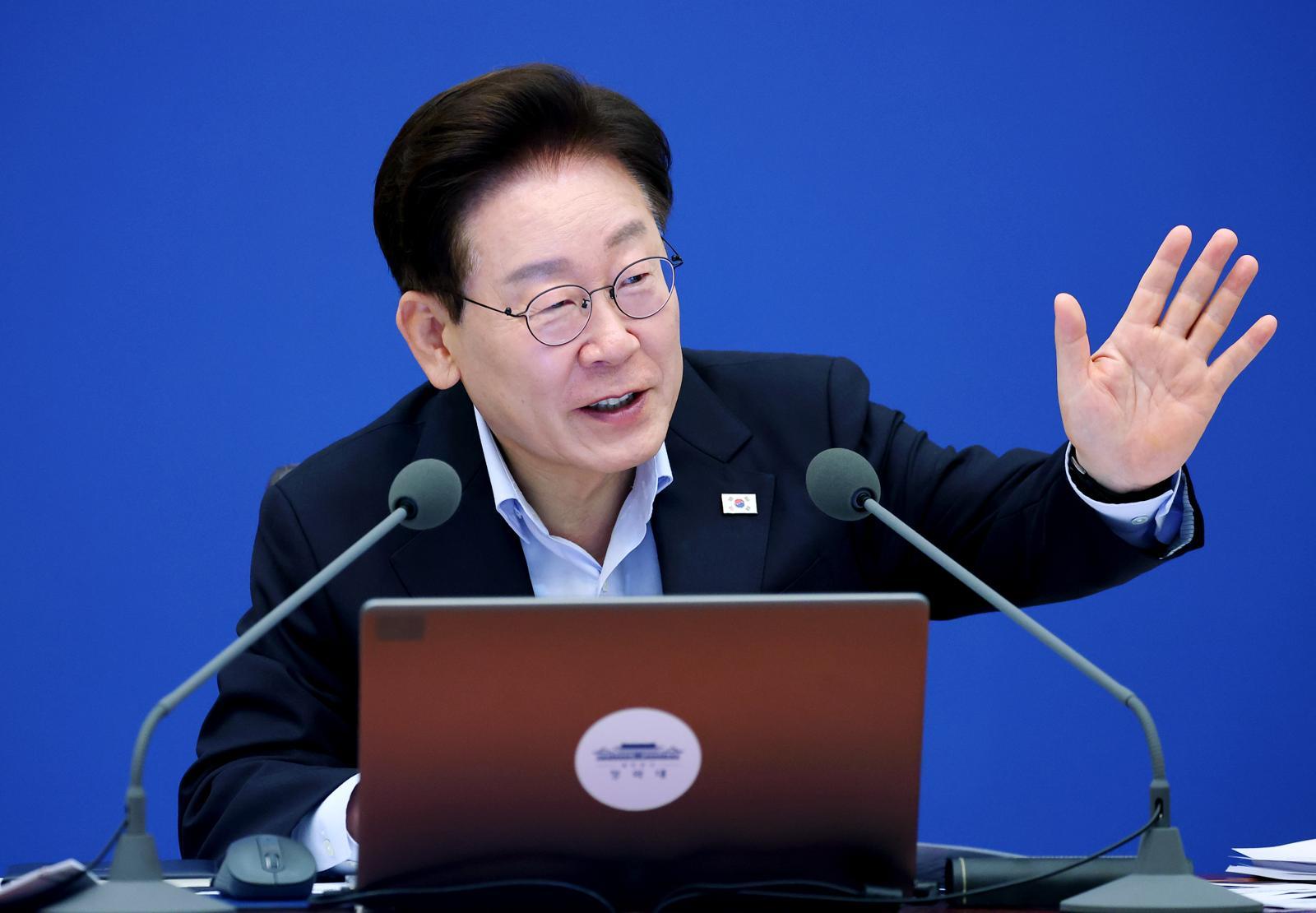
President Lee: Profit-sharing unlikely subject for labor disputes
Translated from Korean, summarized and contextualized by DistantNews.
At a glance
News
Named sources
New plan
- South Korean President Lee Jae-myung stated that profit-sharing based on operating income is likely not a subject for labor disputes.
- He criticized the overly broad interpretation of labor dispute targets following amendments to the Labor Union Act.
- The president ordered the Ministry of Employment and Labor to clarify the scope of labor dispute targets through presidential decrees and enforcement rules.
South Korean President Lee Jae-myung asserted that the distribution of a certain percentage of operating profits is unlikely to be a subject for labor disputes. Speaking at a State Council meeting, he expressed concern that the scope of what constitutes a labor dispute has become excessively broad since the revision of the Labor Union Act.
Is the issue of distributing a certain percentage of operating profits really a subject for dispute? I think it is not.
"Is the issue of distributing a certain percentage of operating profits really a subject for dispute? I think it is not," President Lee stated. He pointed out that while the law provides general standards, the executive branch has the responsibility to establish specific criteria. "The administrative branch is not just a messenger; it is responsible for creating concrete standards," he added, emphasizing the government's role in defining such matters.
The administrative branch is not just a messenger; it is responsible for creating concrete standards.
President Lee specifically referenced the case where some labor unions at Samsung Electronics claimed that the construction of a semiconductor plant in Gwangju was a labor dispute issue. He questioned this interpretation, asking, "If a factory is built in Gwangju, they might be transferred, so they argue it's a labor dispute target. But if you think about it that way, aren't all corporate management activities related?" He criticized the tendency to rely solely on legislative changes to resolve all issues, urging the Ministry of Employment and Labor to provide clear guidelines through presidential decrees, enforcement rules, and directives to define the boundaries of labor dispute targets.
If a factory is built in Gwangju, they might be transferred, so they argue it's a labor dispute target. But if you think about it that way, aren't all corporate management activities related?
DistantNews Editorial
Originally published by Dong-A Ilbo in Korean. Translated, summarized, and contextualized by our editorial team with added local perspective. Read our editorial standards.
More Stories



From Our Blog

What Gets Lost (and Found) When News Is Translated

The Critical Role of Diaspora Media in Global News

What Travellers Should Know About Countries with Restricted Press

A Digital Nomad's Guide to Following Local News

How the Same Story Looks Different in Different Countries
