


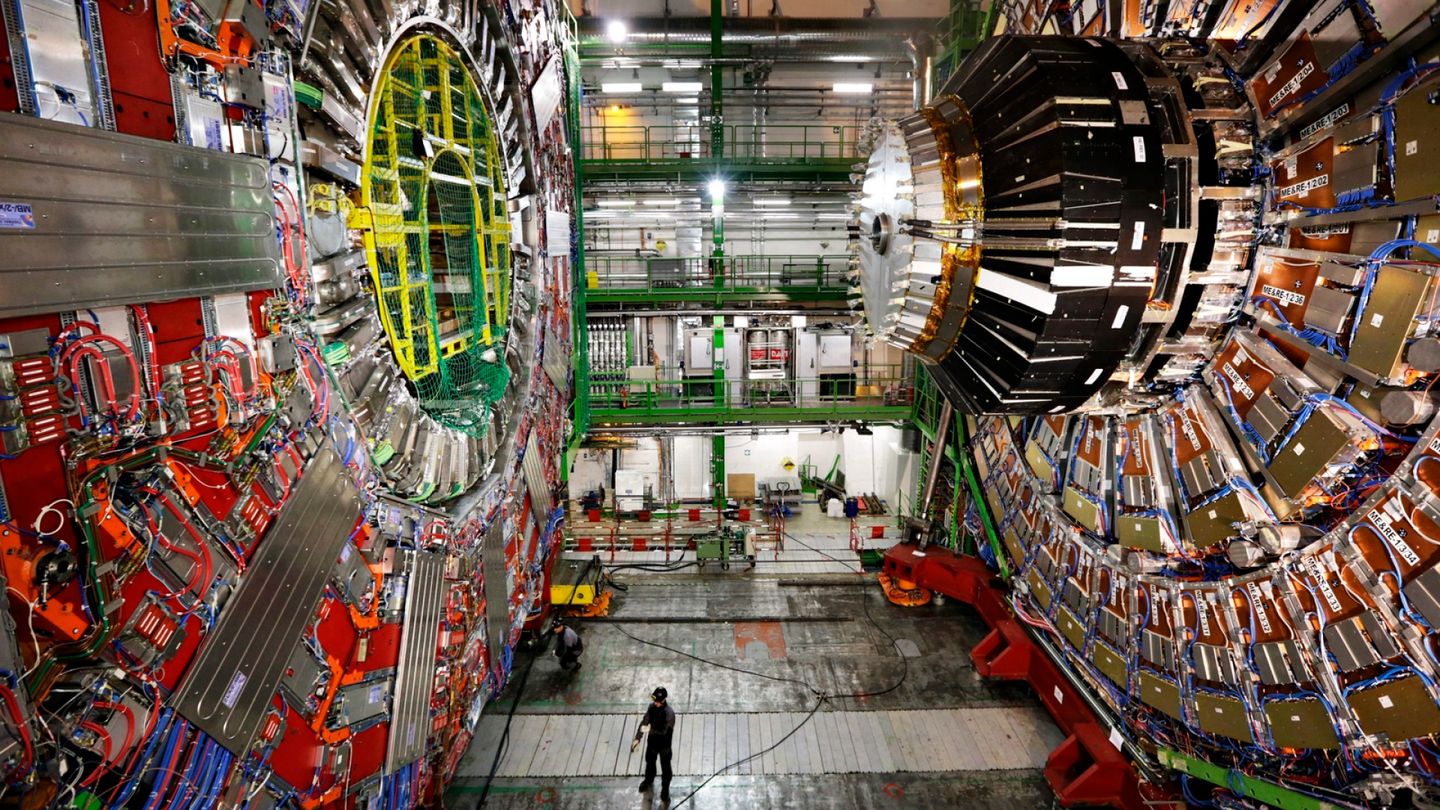
Quark-Gluon Plasma Created at CERN, Shedding Light on Early Universe
Translated from Finnish, summarized and contextualized by DistantNews.
At a glance
News
Sources not specified
Context piece
- Scientists at CERN have created quark-gluon plasma, a state of matter that existed moments after the Big Bang.
- This substance, composed of free elementary particles, filled the early universe but is not found naturally today.
- The experiment involved colliding oxygen and neon atoms, confirming theories about the universe's initial moments and the fundamental nature of matter.
Researchers at CERN have successfully recreated quark-gluon plasma, a primordial state of matter that existed in the universe's first microseconds after the Big Bang. This achievement offers crucial insights into the universe's earliest moments and the fundamental building blocks of matter.
Quark-gluon plasma is an extremely dense and hot substance, estimated to be over 100,000 times hotter than the Sun's core. It filled the early universe before cooling and condensing into the protons and neutrons that form today's matter. Its recreation at CERN involved colliding heavy ions, specifically oxygen and neon atoms, within the Large Hadron Collider.
The experiment's results provide strong support for existing theories about the conditions of the early universe. By studying this plasma, scientists can better understand the fundamental forces and particles that governed the cosmos shortly after its inception. This research pushes the boundaries of particle physics and cosmology, offering a glimpse into the universe's most extreme conditions.
Finnish scientists were among the international collaborators involved in this groundbreaking research at CERN. The findings contribute significantly to our understanding of the universe's evolution and the nature of matter itself.
DistantNews Editorial
Originally published by Helsingin Sanomat in Finnish. Translated, summarized, and contextualized by our editorial team with added local perspective. Read our editorial standards.
More Stories

From Our Blog

What Gets Lost (and Found) When News Is Translated

The Critical Role of Diaspora Media in Global News

What Travellers Should Know About Countries with Restricted Press

A Digital Nomad's Guide to Following Local News

How the Same Story Looks Different in Different Countries
