


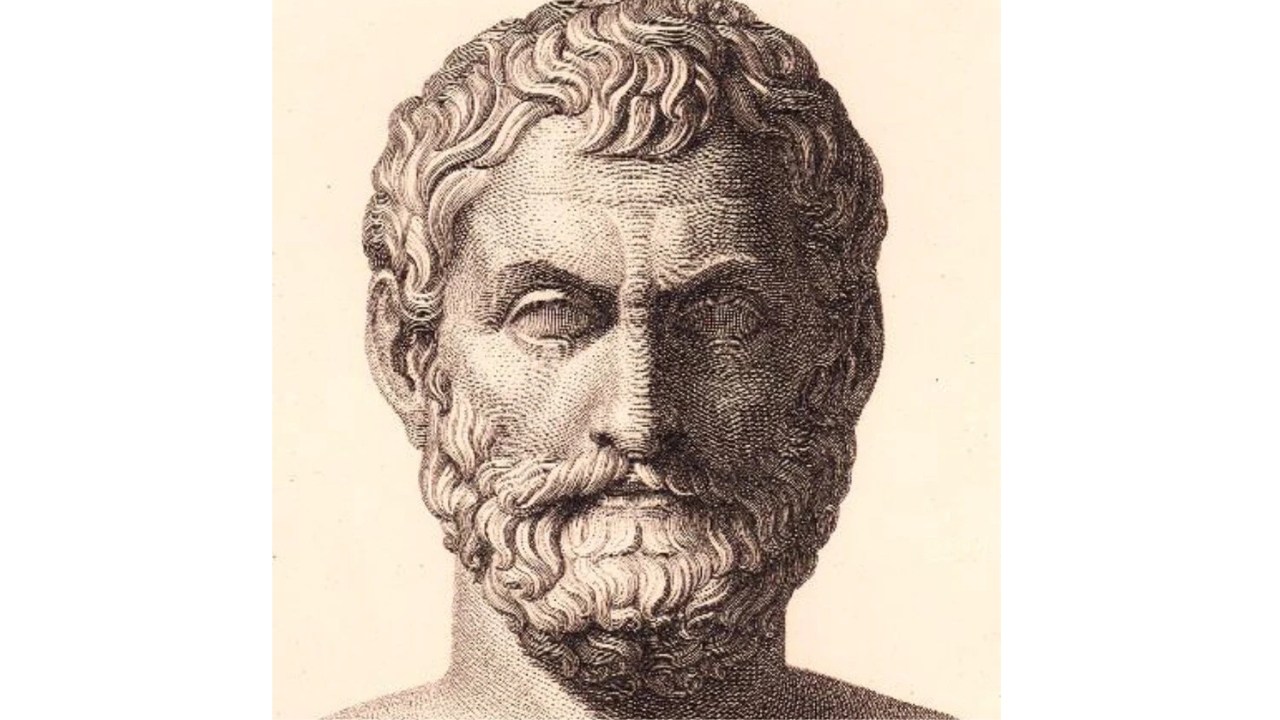
Quote of the Day by Greek philosopher Thales of Miletus: "Hope is the only good that is common to all men…"
Summarized and contextualized by DistantNews.
At a glance
In-depth
Sources not specified
Context piece
- Ancient Greek philosopher Thales of Miletus's quote on hope remains relevant today, emphasizing its universal accessibility.
- Thales, considered the first Western philosopher, sought rational explanations for natural phenomena, laying groundwork for science.
- His reflections on hope highlight its role as an enduring inner strength that fosters resilience and optimism, even in adversity.
Hope, a concept that has sustained humanity through millennia of hardship, was recognized by the ancient Greek philosopher Thales of Miletus as one of life's most profound strengths. His enduring words, "Hope is the only good that is common to all men; those who have nothing else still possess hope," capture a universal truth about its accessibility.
Unlike material wealth, power, or success, which are unevenly distributed, hope remains available to everyone, irrespective of their background or circumstances. This enduring quality has allowed Thales's quote to resonate for over two thousand years. Thales, a pivotal figure in intellectual history, is credited as one of the earliest thinkers to explain the natural world through observation and reason, rather than mythology. His foundational work in philosophy, mathematics, and astronomy, alongside his insights into human nature, continues to hold relevance.
Thales, who lived approximately between 624 BC and 546 BC, is regarded as the first philosopher in the Western tradition and the founder of the Milesian school. His departure from mythological explanations to seek logical, reason-based answers marked a significant shift, paving the way for Western philosophy and scientific inquiry. His contributions extended to mathematics and astronomy, with ancient historians crediting him with predicting a solar eclipse in 585 BC, an early example of scientific foresight.
His philosophical legacy includes the theory that water was the fundamental element of nature, an early attempt to understand the universe through rational thought. This willingness to question established beliefs profoundly influenced subsequent generations of thinkers. In the modern era, facing challenges from financial instability to global crises, hope continues to serve as a crucial emotional anchor. Modern psychological research consistently validates Thales's ancient observation, linking hope to motivation, problem-solving, and resilience in the face of adversity.
Hope is the only good that is common to all men; those who have nothing else still possess hope.
DistantNews Editorial
Originally published by Times of India. Summarized and contextualized by our editorial team with added local perspective. Read our editorial standards.
More Stories

"Wild pursuit of fame and fortune": Candace Owens tears into Erika Kirk, claims Charlie Kirk was her…
Quote of the day by Lao Tzu: 'Time is a created thing. To say ‘I don’t have time,’ is like saying, ‘…

Quote of the day by Xenophanes: 'If horses or oxen or lions had hands… horses would paint the forms …
From Our Blog

What Press Freedom Means for the News You Read

What Gets Lost (and Found) When News Is Translated

The Critical Role of Diaspora Media in Global News

What Travellers Should Know About Countries with Restricted Press

A Digital Nomad's Guide to Following Local News
