

Rare double coronary artery blockage survived by Vietnamese patient
Translated from Vietnamese, summarized and contextualized by DistantNews.
At a glance
News
Sources not specified
Outcome reported
- A 45-year-old man in Ho Chi Minh City survived a rare and critical case of a heart attack involving blockages in two major coronary arteries.
- The patient, a heavy smoker with untreated hypertension and high cholesterol, experienced severe chest pain and breathing difficulties.
- Doctors successfully performed an emergency procedure to clear the blockages and restore blood flow, saving his life.
Doctors at Thu Duc City General Hospital in Ho Chi Minh City have successfully treated a 45-year-old patient who suffered a rare and life-threatening heart attack. The man, identified only as N.N.N., experienced a sudden onset of severe chest pain, radiating to his left shoulder, accompanied by sweating and difficulty breathing, approximately one hour after a meal.
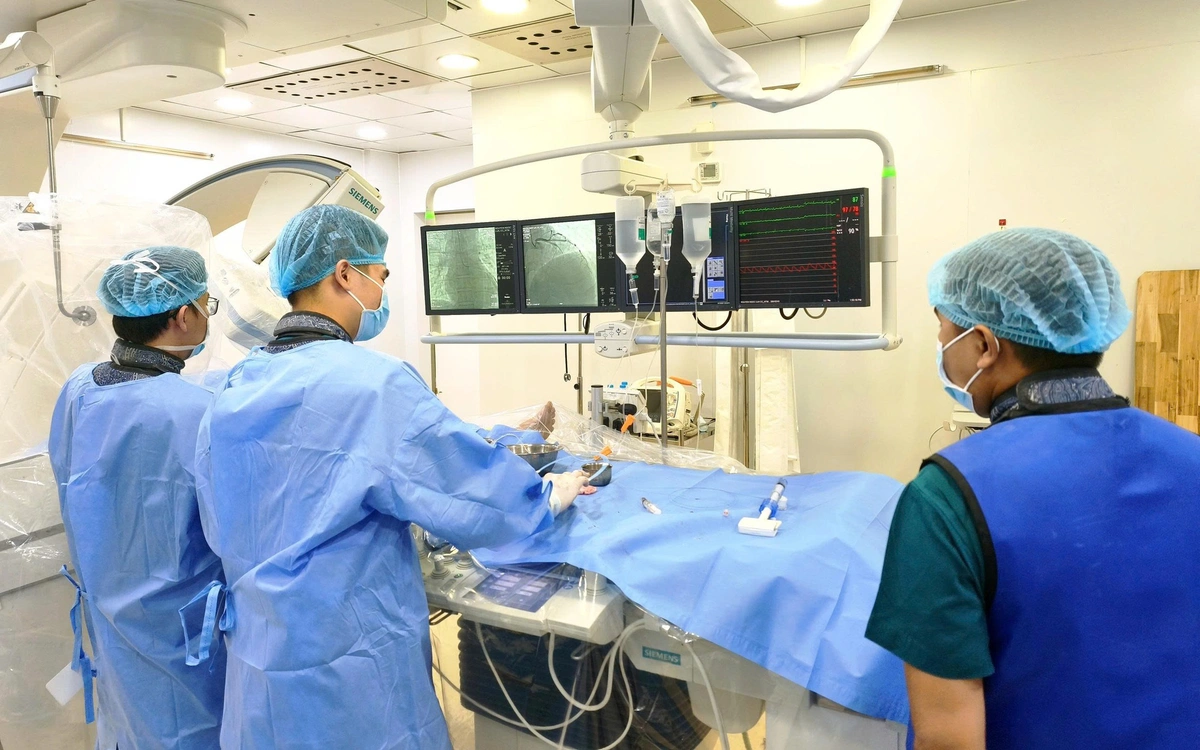
Doctors successfully performed an emergency procedure to clear the blockages and place stents to save the patient.
Upon arrival at a local hospital, he was diagnosed with an acute myocardial infarction and immediately transferred to Thu Duc City General Hospital. Medical history revealed that N.N.N. was a heavy smoker, consuming about a pack of cigarettes daily, and had a long-standing diagnosis of hypertension that he had not managed. His lab results also indicated dyslipidemia, with a high LDL cholesterol level of 157 mg/dL, and pre-diabetes.
Doctors at Thu Duc City General Hospital announced on June 2 that they successfully saved a patient with acute myocardial infarction, a critical case.
At the time of admission, the patient was in distress, experiencing intense chest pain and showing signs of severe oxygen deprivation, with SpO2 levels fluctuating between 85-90% despite oxygen support. Diagnostic imaging confirmed a widespread infarction affecting the inferior and anterior walls of the heart, with significantly reduced heart function observed on echocardiogram.
Myocardial infarction is a cardiovascular emergency with a very high rate of complications and mortality if not intervened in the first hours. At this time, time is heart muscle, because with each passing minute, more heart muscle cells die.
Recognizing the critical condition, an ST-elevation myocardial infarction with potential blockage in multiple coronary arteries and rapidly progressing acute heart failure, the interventional cardiology team moved swiftly. Coronary angiography revealed the critical diagnosis: complete blockages in two of the three main coronary arteries supplying the heart, with the third artery being small. Within an hour, physicians successfully performed an emergency thrombectomy and stenting procedure on both blocked arteries, restoring blood flow. The patient's chest pain significantly subsided post-procedure. Although he continued to experience heart failure, intensive care and subsequent treatment allowed him to stabilize, wean off vasoactive drugs, and be discharged in good health after eight days.
According to medical literature, cases of acute myocardial infarction with blockages in two or more coronary arteries are extremely rare, accounting for only about 2.5% of patients with primary percutaneous coronary intervention (PCI) for acute myocardial infarction. This is also a group of patients with a very high risk of death due to cardiogenic shock or dangerous arrhythmias.
DistantNews Editorial
Originally published by Tuổi Trẻ in Vietnamese. Translated, summarized, and contextualized by our editorial team with added local perspective. Read our editorial standards.
More Stories


From Our Blog

What Gets Lost (and Found) When News Is Translated

The Critical Role of Diaspora Media in Global News

What Travellers Should Know About Countries with Restricted Press

A Digital Nomad's Guide to Following Local News

How the Same Story Looks Different in Different Countries
