


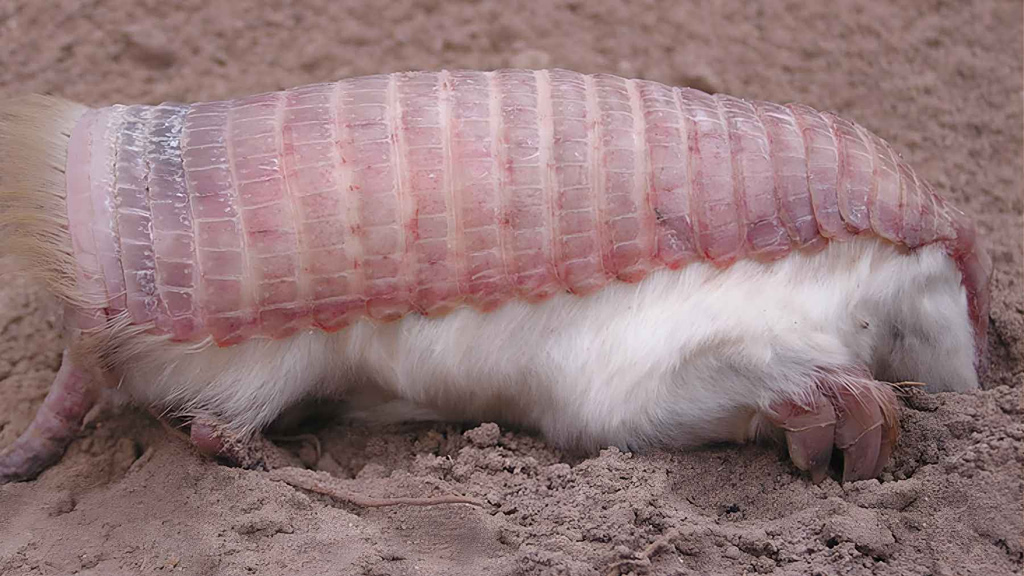
Rare 'Pink Fairy' Armadillo Sighted Again, Exciting Scientists
Translated from Greek, summarized and contextualized by DistantNews.
TLDR
- The rare pink fairy armadillo, nicknamed the 'pink fairy,' has been sighted again in Argentina's Ñacuñán Biosphere Reserve.
- This sighting is considered a positive sign for the ecosystem's health, indicating stable ground and rich native vegetation.
- Scientists emphasize the importance of protecting the entire habitat, not just specific areas, as the species is highly vulnerable to environmental changes and human interference.
The reappearance of the 'pink fairy armadillo,' a creature so elusive it's often called a 'fairy,' has brought a wave of excitement and scientific interest to Argentina. Sighted once again in the Ñacuñán Biosphere Reserve in Mendoza, this tiny mammal's presence is more than just a rare curiosity; it's a vital indicator of the health of its fragile ecosystem. For us in Argentina, where biodiversity is a precious heritage, this sighting reinforces our commitment to conservation.
every confirmed observation is a tangible sign that the ecosystem is functioning
Ignacio Haudet, director of biodiversity, stated that each confirmed observation is a tangible sign that the ecosystem is functioning. This is crucial because the pink fairy armadillo depends on a delicate chain of environmental factors. Its survival is intrinsically linked to stable ground, rich native vegetation, and minimal human disturbance. This perspective underscores why our conservation efforts must focus on preserving entire habitats, not just isolated pockets of nature.
Iván Funes Pinter, head of protected areas, highlighted that Ñacuñán safeguards not just landscapes but entire ecological dynamics. The threats to species like the pink fairy armadillo are often subtle – small, repeated human interventions that gradually alter the environment. Adrián Gorrindo, head of fauna, further explained that the animal requires stable, unpolluted soils, making every sighting exceptionally valuable for scientific understanding. This emphasizes the unique local perspective: we understand the intricate balance of our natural world and the quiet threats it faces, which might be missed by broader international coverage.
Ñacuñán does not just preserve landscapes, but entire ecological dynamics
As the smallest living armadillo, measuring only 7 to 10 centimeters, the pink fairy armadillo spends most of its life underground. Its classification as 'Data Deficient' by the IUCN means we still have much to learn. However, its vulnerability to stress and habitat fragmentation due to agricultural activities, as well as threats from domestic animals, makes these sightings incredibly significant. From our viewpoint in Argentina, protecting this unique creature is not just about saving a species; it's about safeguarding the delicate ecological tapestry that defines our natural heritage.
the animal requires stable soils without intense intervention or pollution, something that makes every observation extremely valuable for science
DistantNews Editorial
Originally published by Ta Nea in Greek. Translated, summarized, and contextualized by our editorial team with added local perspective. Read our editorial standards.
More Stories



From Our Blog

What Gets Lost (and Found) When News Is Translated

The Critical Role of Diaspora Media in Global News

What Travellers Should Know About Countries with Restricted Press

A Digital Nomad's Guide to Following Local News

How the Same Story Looks Different in Different Countries
