


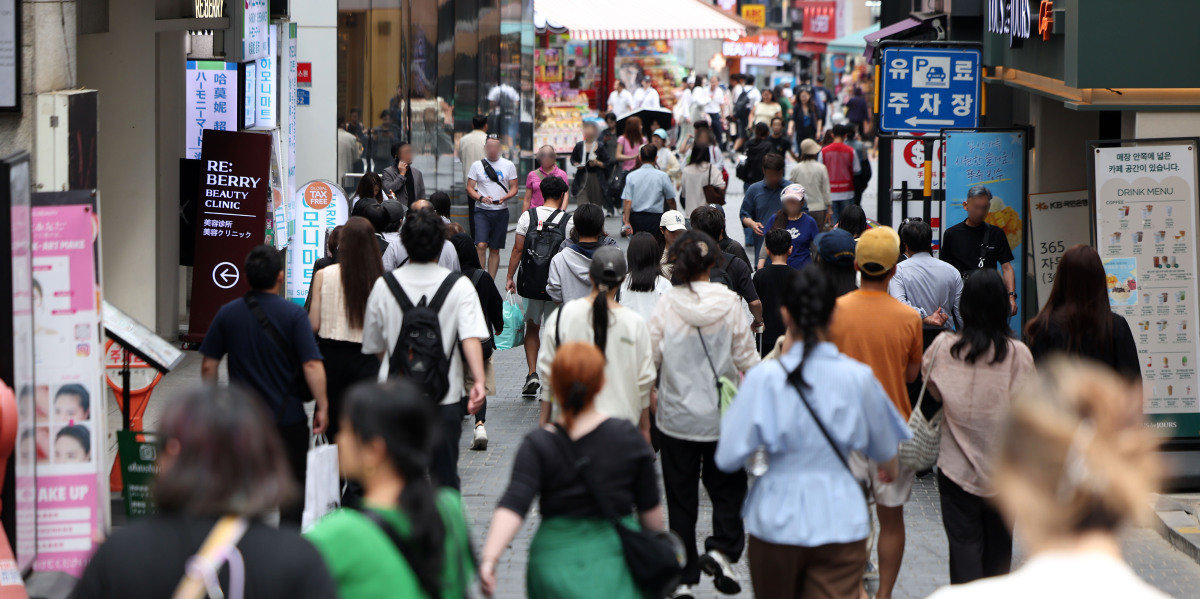
Record foreign tourists flock to South Korea, boosting domestic economy amid weak won and Hallyu wave
Translated from Korean, summarized and contextualized by DistantNews.
At a glance
News
Named sources
Context piece
- Foreign tourist arrivals and spending in South Korea have reached record highs, driven by a weaker won and the popularity of Korean culture.
- From January to June 20, over 10 million foreign tourists visited, a first for the first half of the year, with spending increasing by 49% year-on-year.
- This surge in tourism is boosting domestic consumption, offering a much-needed stimulus to the economy, though strategies to benefit small businesses are being considered.
South Korea is experiencing an unprecedented surge in foreign tourism, with both visitor numbers and spending hitting record highs. This boom is largely attributed to the weaker South Korean won, making the country a more attractive and affordable destination, alongside the enduring global appeal of Korean culture and entertainment.
The proportion of foreign customers exceeds 40% even in small stores in office districts. Their nationalities are diverse, including Indonesia, Thailand, the United States, Canada, and Australia. Recently, there have definitely been more Westerners.
Data from the Ministry of Culture, Sports and Tourism reveals that over 10 million foreign tourists visited between January 1 and June 20, marking the first time this milestone was reached in the first half of a year. This influx is not just about numbers; tourist spending has also significantly increased. From January to May, while tourist numbers rose 21% year-on-year to 8.7 million, their spending, estimated through credit card data, jumped by 49% to 7.78 trillion won. The spending in May alone surpassed 2 trillion won for the first time.
Experts highlight the dual impact of a weaker currency and the "Hallyu" wave, or Korean Wave, in boosting the country's allure. Professor Jeong Cheol of Hanyang University's Tourism Department noted that a weaker won makes Korean travel packages about 20% cheaper for foreigners. "For foreigners, Korea is seen as a must-visit destination in a lifetime," he added, emphasizing the cultural draw.
The effect of the weak won was significant. As the won/dollar exchange rate rose from 1200 to 1500, it became about 20% cheaper for foreign tourists to purchase Korean travel products, increasing Korea's attractiveness as a travel destination.
Major retailers like Lotte Department Store and Shinsegae Department Store have reported record foreign sales in the first half of the year, nearing or even surpassing previous annual figures. Notably, the demographic of foreign shoppers is diversifying, with a decrease in Chinese customers and a significant rise in visitors from the US and Southeast Asia. This trend underscores a shift in tourist origins and preferences, moving beyond traditional markets.
With the spread of K-content, Korea's attractiveness has increased, leading to expanded consumption in various fields such as shopping, gourmet food, beauty, medical care, and cultural experiences, centered on independent travelers and repeat visitors who travel without package tours or guides.
As the tourism boom benefits large corporations, there's a growing call to extend these advantages to small businesses and local entrepreneurs. Experts suggest strategies like enhancing digital marketing capabilities for small businesses, supporting multilingual services, and developing "experiential tourism" that encourages visitors to explore local neighborhoods, bakeries, and cafes. Such initiatives could further solidify tourism's role as a vital engine for domestic economic growth.
When one foreign tourist increases, it's equivalent to an increase of 0.07 domestic consumers.
DistantNews Editorial
Originally published by Dong-A Ilbo in Korean. Translated, summarized, and contextualized by our editorial team with added local perspective. Read our editorial standards.
More Stories



From Our Blog

What Gets Lost (and Found) When News Is Translated

The Critical Role of Diaspora Media in Global News

What Travellers Should Know About Countries with Restricted Press

A Digital Nomad's Guide to Following Local News

How the Same Story Looks Different in Different Countries
