


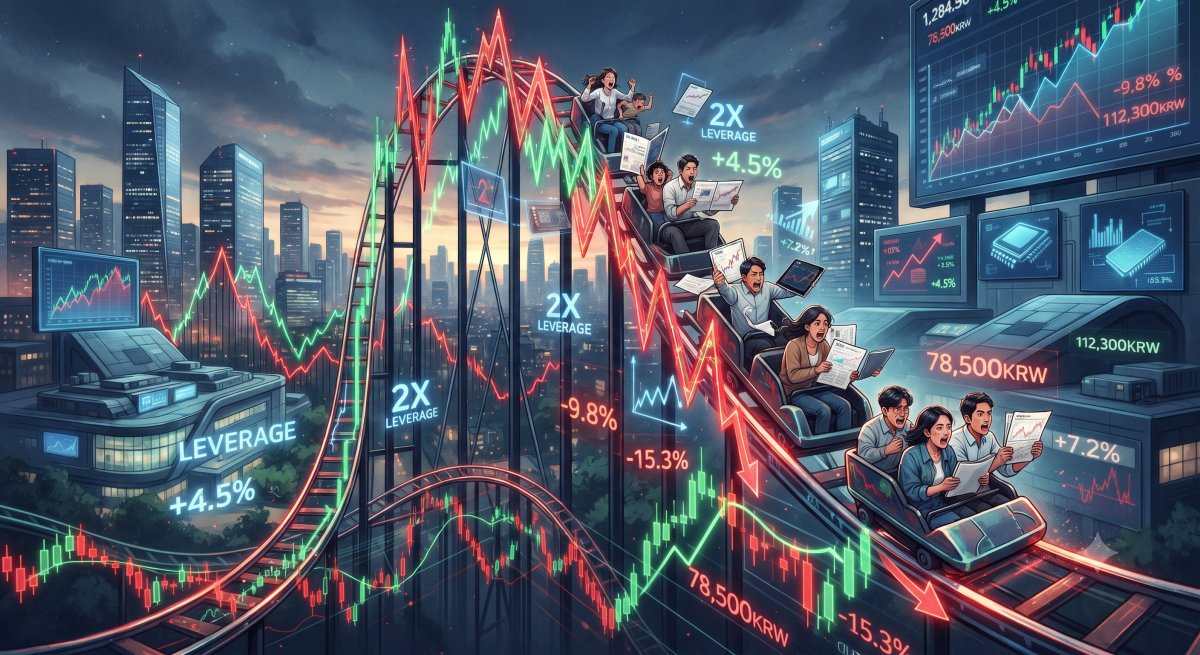
Retail investors face losses as leveraged ETFs cause KOSPI volatility
Translated from Korean, summarized and contextualized by DistantNews.
At a glance
News
Sources not specified
Context piece
- Retail investors in South Korea are suffering significant losses due to leveraged ETFs tracking single stocks like Samsung Electronics and SK Hynix, with 14 such ETFs posting negative returns within a month of their launch.
- The surge in volatility in the KOSPI, partly attributed to these leveraged ETFs, has led to market disruptions, including the frequent activation of trading curbs, with international media highlighting the disproportionate impact of these funds on the Korean market.
- Despite warnings and the inherent risks of leveraged products, many investors, particularly those with smaller financial assets, are heavily invested in these ETFs, leading to calls for regulatory action, including delisting, due to concerns about investor protection and the potential for market manipulation.
South Korean retail investors are facing a financial rollercoaster, with many experiencing substantial losses from leveraged Exchange Traded Funds (ETFs) that track single stocks, particularly Samsung Electronics and SK Hynix. Since the launch of 14 such ETFs on May 27, which aim to double the daily returns of these semiconductor giants, the KOSPI market has been thrown into turmoil. The extreme volatility has triggered trading curbs like sidecars multiple times a day.
I invested 1 million won in a leveraged product because I didn't have enough money to buy SK Hynix. I've been nicknamed 'the peak predictor' among my friends.
International media, including The Wall Street Journal, has pointed to these leveraged ETFs as a significant factor behind the KOSPI's wild swings. The report noted that while similar funds exist in the U.S., their scale in Korea is disproportionately large compared to the underlying assets. The combined market capitalization of single-stock leveraged ETFs for SK Hynix alone reaches approximately 9 trillion won, surpassing even the Nvidia leveraged ETF in the U.S., despite Nvidia's market cap being four times larger. This intense focus on leveraged investments in Korea underscores a fervent, and potentially risky, appetite among investors.
I was worried about being left out of the semiconductor rally, so I bought leveraged ETFs for both companies. I sold them all recently. The decisive factor was when Samsung Electronics' stock plummeted by 12.31% in a single day, causing the leveraged ETF to drop by nearly 24%.
Investors like a 20-something identified as 'A' and a 30-something 'B' have shared harrowing experiences. 'A' invested 1 million won in an SK Hynix leveraged ETF, only to be nicknamed 'the peak predictor' among friends after incurring losses. 'B', who had previously invested in S&P500 ETFs, felt left out of the semiconductor rally and bought into the leveraged ETFs, only to see his investment plummet by nearly 24% in a single day when Samsung Electronics' stock dropped 12.31%. Many investors are holding onto these leveraged ETFs despite significant losses, hoping for a market rebound, a strategy that can exacerbate losses due to the 'negative compounding effect' where price fluctuations lead to cumulative losses.
The market players have no real benefit, and only the systems managing and operating them profit. I personally have serious concerns about this.
The controversy is further fueled by the substantial fees charged by the ETFs, which range from 0.6% to 1.0% annually, three to five times higher than typical ETFs. This means that securities firms and asset managers profit regardless of investor outcomes. Financial authorities have expressed serious concerns, with Financial Services Commission Chairman Lee Bok-hyun stating his worry about systems that profit while market participants do not. The situation has escalated to the point where some politicians are calling for the delisting of these products, with Ahn Cheol-soo, a member of the ruling People Power Party, advocating for strong corrective measures, including potential delisting, to stabilize the market.
Leveraged 'Samseonik' (Samsung and Hynix) is a complete policy failure. Strong corrective measures, including delisting, are needed for market normalization.
DistantNews Editorial
Originally published by Dong-A Ilbo in Korean. Translated, summarized, and contextualized by our editorial team with added local perspective. Read our editorial standards.
More Stories


From Our Blog

What Gets Lost (and Found) When News Is Translated

The Critical Role of Diaspora Media in Global News

What Travellers Should Know About Countries with Restricted Press

A Digital Nomad's Guide to Following Local News

How the Same Story Looks Different in Different Countries
