


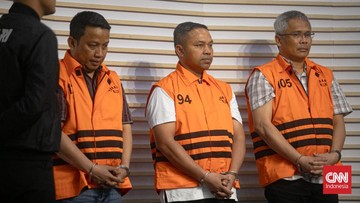
Riau Governor appeals 2-year sentence in corruption case, claims fabrication
Translated from Indonesian, summarized and contextualized by DistantNews.
At a glance
News
Named sources
In the courts
- Riau Governor Abdul Wahid has appealed his two-year prison sentence for a 'preman quota' corruption case.
- Wahid claims the trial ignored crucial facts and that the case was fabricated, asserting his innocence.
- He was initially sentenced to two years, a reduction from the prosecutor's initial demand of 8 years and 6 months.
Non-active Riau Governor Abdul Wahid is appealing his two-year prison sentence handed down in a corruption case involving 'preman quota' (protection money). Wahid expressed disappointment with the verdict, stating that the court did not consider any mitigating factors.
Following the verdict read at the Pekanbaru Corruption Court, Wahid maintained his innocence, describing the case as a fabrication. "I feel I am not guilty in this matter and I never did it. But it was truly engineered, I feel that this is full of engineering," he stated.
We both heard the judge's decision. However, from the judge's decision, there were no mitigating considerations for me.
Wahid was arrested in an anti-graft operation in early November 2025. The two-year sentence is significantly less than the 8 years and 6 months initially sought by the Corruption Eradication Commission (KPK) prosecutor. The prosecutor had also sought a Rp500 million fine and restitution of Rp1.450 billion.
The initial charges alleged that Abdul Wahid was proven guilty of corruption. He faced potential penalties under Indonesia's anti-corruption laws, with provisions for imprisonment and asset seizure if fines or restitution were not paid.
Hopefully, I will get justice and I will continue to seek justice. I feel I am not guilty in this matter and I never did it. But it was truly engineered, I feel that this is full of engineering.
DistantNews Editorial
Originally published by CNN Indonesia in Indonesian. Translated, summarized, and contextualized by our editorial team with added local perspective. Read our editorial standards.
More Stories



From Our Blog

What Gets Lost (and Found) When News Is Translated

The Critical Role of Diaspora Media in Global News

What Travellers Should Know About Countries with Restricted Press

A Digital Nomad's Guide to Following Local News

How the Same Story Looks Different in Different Countries
