


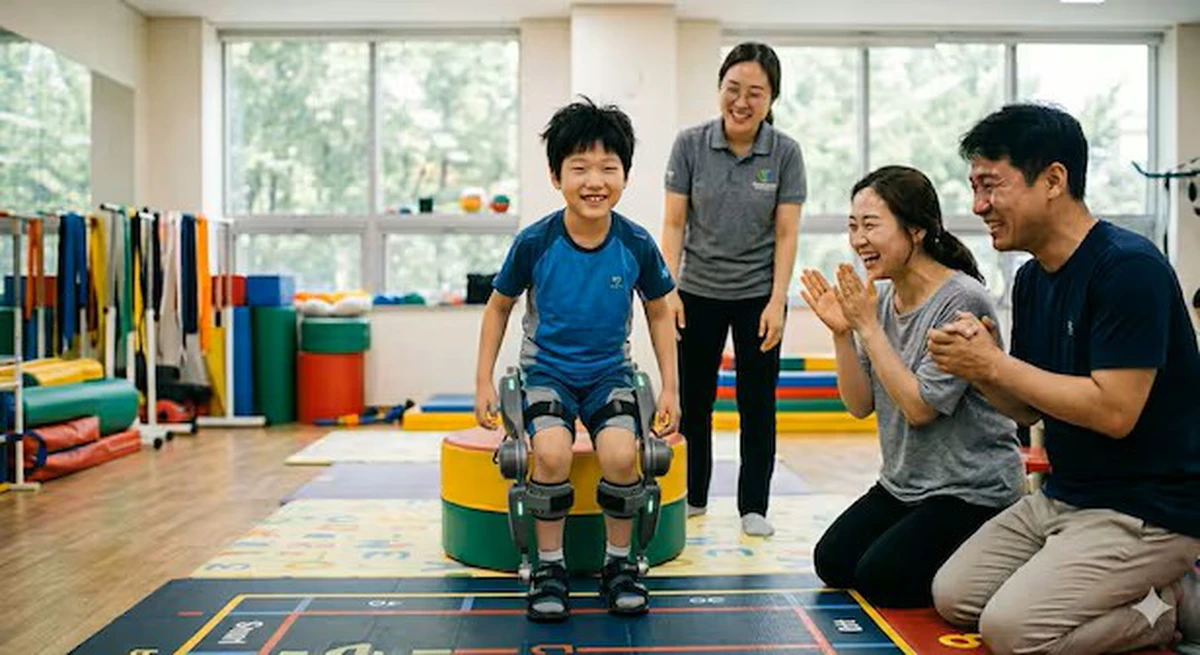
Robot-Assisted Game Helps Children with Muscle Atrophy Stand Tall
Translated from Vietnamese, summarized and contextualized by DistantNews.
At a glance
News
Sources not specified
Context piece
- Six children in China with spinal muscular atrophy (SMA) can now stand independently after six weeks using a novel robot-assisted therapy.
- The new robot uses resistance, not just support, to help patients retrain their muscles and nervous systems, unlike traditional rehabilitation robots.
- This research, a collaboration between Chinese universities and MIT, has shown significant improvements in limb mobility and muscle strength, with plans to expand the technology internationally.
A groundbreaking robot-assisted therapy has enabled six children in China, previously unable to stand due to spinal muscular atrophy (SMA), to regain their ability to stand independently after just six weeks of treatment. The innovative approach, detailed in a report by the South China Morning Post, focuses on retraining the neuromuscular system rather than simply providing physical support.
SMA is a genetic disorder that progressively damages nerve cells controlling muscles, leading to muscle weakness, atrophy, and potentially severe mobility issues. While current treatments can slow the disease's progression, they cannot reverse its effects. This new robotic system, however, offers a different paradigm.
Developed through a collaboration involving Beihang University, Peking University Third Hospital, and the Massachusetts Institute of Technology (MIT), the robot employs resistance-based training. Professor Feng Yanggang of Beihang University explained that traditional support robots might hinder muscle development in SMA patients. Conversely, this resistance robot encourages neuromuscular development by requiring patients to actively engage their muscles.
For these users, wearing a resistance robot is more suitable for promoting neuromuscular development.
During the trial, children aged six to ten played a soccer video game by extending their legs against the robot's calibrated resistance. This forced their muscles and nerves to work together. After six weeks, participants showed remarkable improvements: muscle size increased by 19%, range of motion by 51%, and muscle strength by 130%. Crucially, these gains were maintained even after the robot therapy concluded.
The research team has received numerous inquiries from international patients and plans to make this technology accessible globally, offering new hope for individuals affected by SMA.
After the paper was published, the research team received many requests for support from foreign patients, and they plan to promote this device to the international SMA patient community.
DistantNews Editorial
Originally published by Tuổi Trẻ in Vietnamese. Translated, summarized, and contextualized by our editorial team with added local perspective. Read our editorial standards.
More Stories



From Our Blog

What Gets Lost (and Found) When News Is Translated

The Critical Role of Diaspora Media in Global News

What Travellers Should Know About Countries with Restricted Press

A Digital Nomad's Guide to Following Local News

How the Same Story Looks Different in Different Countries
