


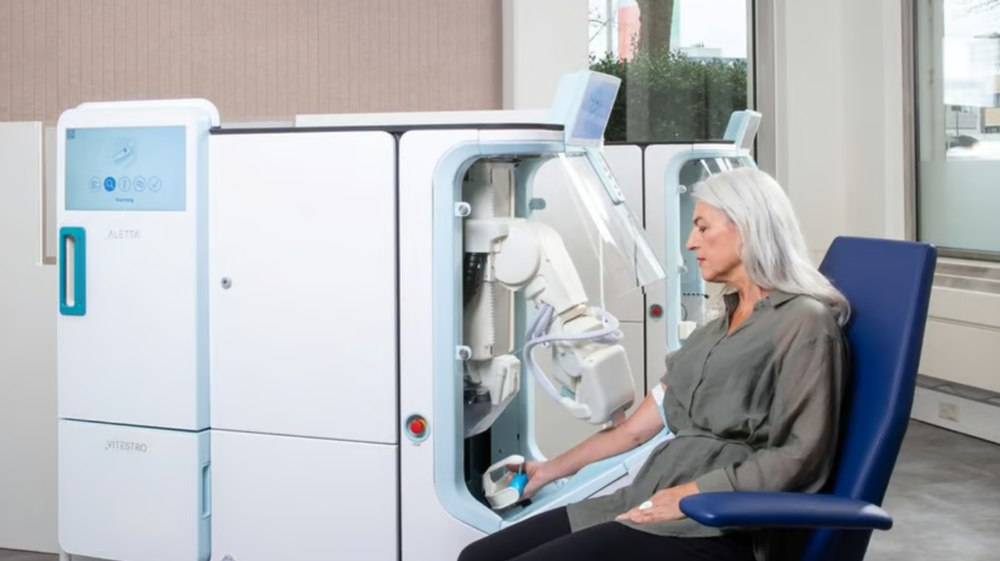
Robot that draws blood without direct doctor intervention approved by FDA
Translated from Romanian, summarized and contextualized by DistantNews.
At a glance
News
Official statement
Approved/passed
- The U.S. FDA has authorized Aletta, the first autonomous robotic device capable of drawing blood without direct human intervention.
- A trained phlebotomist can supervise up to three Aletta devices simultaneously.
- The robot uses infrared light and ultrasound to find veins, performing all steps from vein identification to bandaging.
The U.S. Food and Drug Administration (FDA) has authorized Aletta, a groundbreaking robotic device designed to autonomously collect blood samples. This marks the first time a robot can perform blood draws from a patient's arm without direct supervision from a healthcare professional.
A trained phlebotomist can oversee up to three Aletta devices concurrently, according to an FDA statement. Michelle Tarver, director of the FDA's Center for Devices and Radiological Health, stated that this authorization underscores the agency's commitment to advancing innovative medical devices that address critical public health needs while maintaining safety and efficacy.
The Aletta robot manages every stage of the blood collection process independently, though a session must be initiated by a trained phlebotomist who remains available for assistance. The device guides the patient on arm positioning, and the collection begins after a button press. It employs near-infrared light and Doppler ultrasound to accurately identify a suitable vein, distinguishing it from arteries. If an appropriate vein is not found, the device will not proceed with the collection.
Once a vein is identified, Aletta automatically executes the subsequent steps: applying a tourniquet, preparing the skin, inserting and removing the needle, changing collection tubes, and applying a bandage. A phlebotomist then verifies the correct filling order of the tubes and sufficient sample volume. The device incorporates multiple safety features, including continuous skin disinfection during ultrasound scanning and automatic needle detachment if the patient moves excessively, halting the procedure. Other integrated sensors can suspend the process and alert the supervisor to unsafe conditions.
FDA authorization is based on clinical data demonstrating that Aletta achieves success rates comparable to or better than trained phlebotomists. The evaluation included diverse patient groups, including those with difficult-to-access veins and varying skin tones. Adverse events associated with the device were reported as rare and mild. The FDA granted Vitestro marketing authorization for Aletta through the De Novo pathway, intended for novel, low-to-moderate risk medical devices, establishing special controls to ensure safety and effectiveness.
This authorization reflects the FDA's commitment to promoting innovative medical devices that help address a critical public health need while maintaining the safety and effectiveness levels that patients deserve.
DistantNews Editorial
Originally published by Adevărul in Romanian. Translated, summarized, and contextualized by our editorial team with added local perspective. Read our editorial standards.
More Stories

From Our Blog

What Gets Lost (and Found) When News Is Translated

The Critical Role of Diaspora Media in Global News

What Travellers Should Know About Countries with Restricted Press

A Digital Nomad's Guide to Following Local News

How the Same Story Looks Different in Different Countries
