


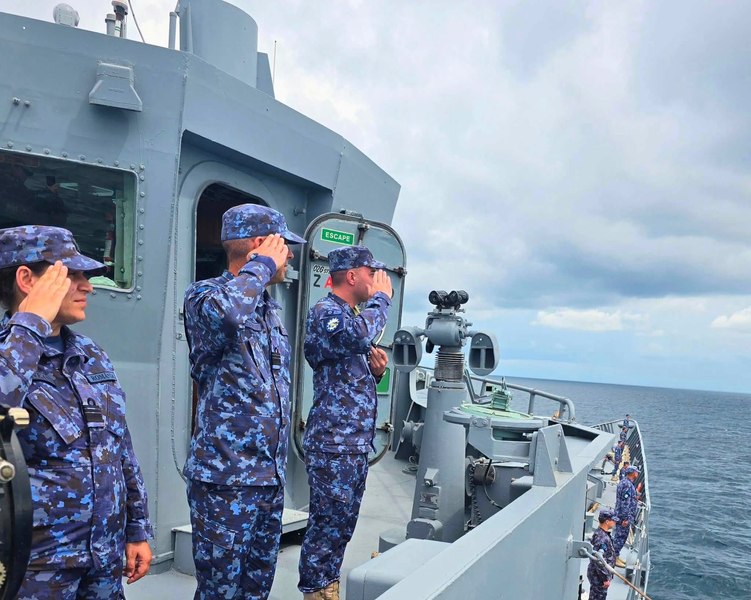
Romania receives first new warship in over 30 years
Translated from Romanian, summarized and contextualized by DistantNews.
At a glance
News
Sources not specified
New plan
- Romania received its first new large combat ship in over 30 years, the HISAR-class corvette "Contraamiral August Roman".
- The delivery, part of a Romania-Turkey defense industry cooperation agreement, enhances Romania's Black Sea defense capabilities.
- The modern corvette is equipped for various missions including surveillance, anti-submarine warfare, and can operate an embarked helicopter.
Romania's naval forces have welcomed the "Contraamiral August Roman," a HISAR-class corvette, marking the first new large combat vessel acquisition in over three decades. This delivery signifies a crucial step in modernizing the Romanian military fleet and bolstering its defense posture in the Black Sea.
The corvette was supplied under a defense industry cooperation agreement between Romania and Turkey, signed in December 2025. This project aligns with Romania's broader efforts to enhance its naval capabilities and adapt to evolving security demands in the region.
Designed for diverse missions, the "Contraamiral August Roman" can perform maritime surveillance, reconnaissance, patrol, and interdiction. It is also capable of search and rescue operations, surface warfare, anti-air defense, and anti-submarine warfare, including the operation of an embarked helicopter. The vessel measures approximately 99.5 meters in length with a displacement of about 2,300 tons and can reach speeds exceeding 24 knots.
Its onboard systems include a 76mm main gun, remote-controlled weapon stations, fire control radar with an integrated electro-optical sensor, electronic warfare systems, hull-mounted sonar, and NATO-compatible communication systems. The corvette enters service in an initial operational configuration, with potential for future upgrades and integration of additional combat systems and sensors.
The delivery represents a significant milestone in bilateral defense cooperation between Romania and Turkey, facilitated through an intergovernmental mechanism and involving the Turkish company ASFAT. This development occurs as NATO's eastern flank members reassess their military capacities, prioritizing maritime security in the Black Sea.
DistantNews Editorial
Originally published by Adevărul in Romanian. Translated, summarized, and contextualized by our editorial team with added local perspective. Read our editorial standards.
More Stories

From Our Blog

What Gets Lost (and Found) When News Is Translated

The Critical Role of Diaspora Media in Global News

What Travellers Should Know About Countries with Restricted Press

A Digital Nomad's Guide to Following Local News

How the Same Story Looks Different in Different Countries
