

Romanian Highway Lane Closed After Land Subsidence; Safety Concerns Halt Bidirectional Traffic
Translated from Romanian, summarized and contextualized by DistantNews.
At a glance
News
Named sources
Ongoing story
- Traffic on Romania's A10 Sebeș-Turda highway has been temporarily closed on one lane due to a land subsidence near kilometer 66+300.
- The National Company of Road Infrastructure Administration (CNAIR) rejected using the other lane for bidirectional traffic, citing safety concerns related to the geological instability.
- CNAIR stated that remediation works will be fully covered by the constructor, and the lane will reopen once geotechnical reports confirm safety.
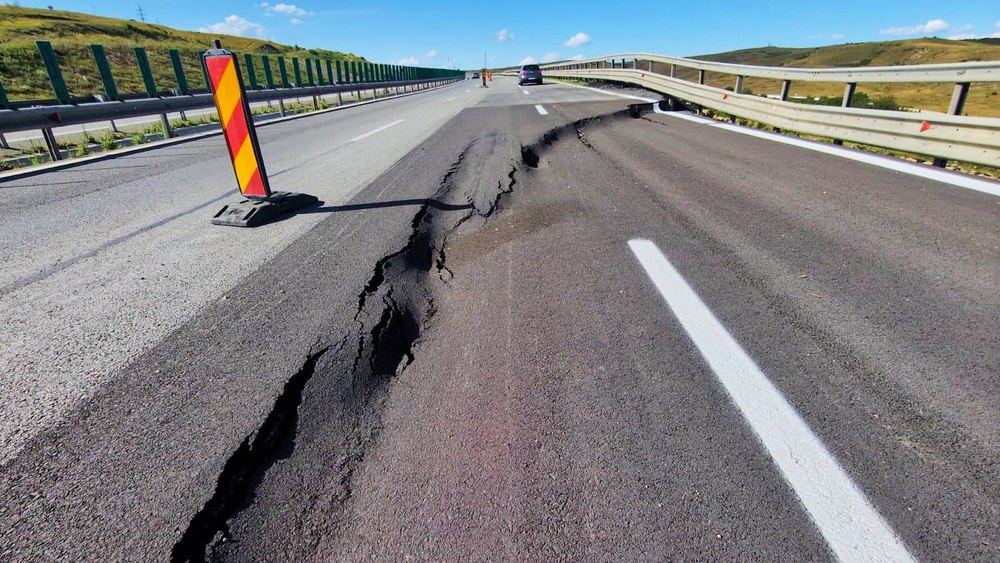
The National Company of Road Infrastructure Administration (CNAIR) has temporarily closed one lane of the A10 Sebeș-Turda highway in Romania, near kilometer 66+300, following a land subsidence. The authority has opted to divert traffic to the DN1 national road, rejecting the option of bidirectional traffic on the remaining lane due to significant safety concerns.
We decided to temporarily close Lane 1 and divert traffic to DN1, on a section only 5 km longer than the proposed alternative. Not out of convenience, but out of responsibility.
Cristian Pistol, the Director General of CNAIR, explained on Facebook that the subsidence involves an "active failure of the road body" – a landslide with unpredictable evolution. He emphasized that the proposed "European solution" of using the second lane for two-way traffic was analyzed and dismissed by CNAIR specialists. Both lanes are founded on the same geological formation and, in some sections, the same embankment. Moving all traffic, including heavy vehicles, close to an active failure zone with repeated acceleration and braking on an incline could accelerate a collapse.
Pistol highlighted additional serious risks associated with bidirectional traffic on the single open lane. These include a head-on collision risk with relative impact speeds exceeding 150 km/h due to traffic on a single incline lane without a slow vehicle lane or emergency shoulder. Furthermore, transfer points between lanes are statistically the most dangerous areas for deviations, especially at night or in fog, and could impede emergency services.
The 'European solution' invoked, bidirectional traffic on Lane 2, was analyzed by CNAIR specialists and rejected for safety reasons: Lane 1 and Lane 2 are founded on the same geological formation and, in sections, on the same embankment body. Moving all traffic, including heavy traffic, a few meters from an active failure, with repeated accelerations and braking on an incline, could accelerate the collapse, under traffic. That is, exactly what we are trying to prevent.
He stressed that current regulations and European directives are based on the principle of not adopting a solution that generates a greater risk than it eliminates. "I will not put drivers in a situation of circulating in the opposite direction, on an incline, just a few meters from an active landslide, only to save a few minutes. Safety is not negotiable," Pistol affirmed. The remediation works will be fully financed by the constructor, not the state budget. CNAIR will reinstate normal traffic flow once geotechnical reports confirm it is safe.
I will not put drivers in a situation of circulating in the opposite direction, on an incline, just a few meters from an active landslide, only to save a few minutes. Safety is not negotiable.
DistantNews Editorial
Originally published by Adevărul in Romanian. Translated, summarized, and contextualized by our editorial team with added local perspective. Read our editorial standards.
More Stories
From Our Blog

What Gets Lost (and Found) When News Is Translated

The Critical Role of Diaspora Media in Global News

What Travellers Should Know About Countries with Restricted Press

A Digital Nomad's Guide to Following Local News

How the Same Story Looks Different in Different Countries
