


Romanian language exam's third question may 'trap' students, warns teacher
Translated from Romanian, summarized and contextualized by DistantNews.
At a glance
News
Named sources
Context piece
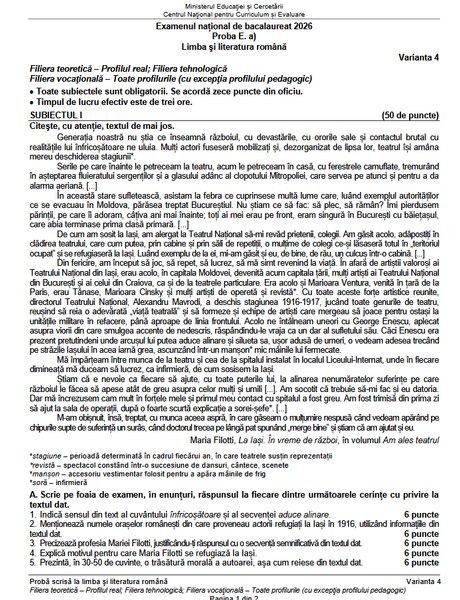
- Romanian language exam subjects for the autumn Baccalaureate session have been released, with analysis suggesting the third essay question may challenge students unfamiliar with prose analysis.
- An educator noted that the first two subjects were accessible, covering word meanings, character origins, and author professions, with clear answers available in the provided text.
- The third subject, requiring analysis of prose, could be a "trap" for students who only summarize instead of engaging with deeper literary interpretation.
Romania's Ministry of Education has released the subjects and grading rubrics for the autumn session of the 2026 Baccalaureate exam in Romanian Language and Literature. An analysis by Ruxandra Achim, a teacher at "I.L. Caragiale" National College in Bucharest, suggests that while the initial sections are straightforward, the third essay question poses a potential pitfall for students.
Achim explained that the first subject, focusing on text-based exercises, should have been easily managed by students. Questions on word meanings, such as "înfricoșătoare" (frightening), offered multiple correct synonyms like "îngrozitoare" (horrifying) or "înspăimântătoare" (terrifying). Similarly, identifying character origins and professions, like actress Maria Filotti, were clearly stated within the provided text fragments, making them readily identifiable.
The second subject, concerning the characters' hometowns (Bucharest and Craiova), was also presented clearly. The third section, which delves into the author's moral traits, allowed students to draw from the entire text. Achim highlighted that traits like dedication to work, optimism, and the contribution of theatrical and hospital activities to wartime morale were evident, along with the author's sense of fulfillment in alleviating suffering.
However, Achim cautioned that the third essay, requiring prose analysis, could "trap" students who are accustomed to merely summarizing plot points rather than engaging in deeper interpretation. The thematic section of the first subject, concerning personal or cultural experiences, was deemed generous and easily adaptable for students to connect with.
DistantNews Editorial
Originally published by Adevărul in Romanian. Translated, summarized, and contextualized by our editorial team with added local perspective. Read our editorial standards.
More Stories



From Our Blog

What Gets Lost (and Found) When News Is Translated

The Critical Role of Diaspora Media in Global News

What Travellers Should Know About Countries with Restricted Press

A Digital Nomad's Guide to Following Local News

How the Same Story Looks Different in Different Countries
