


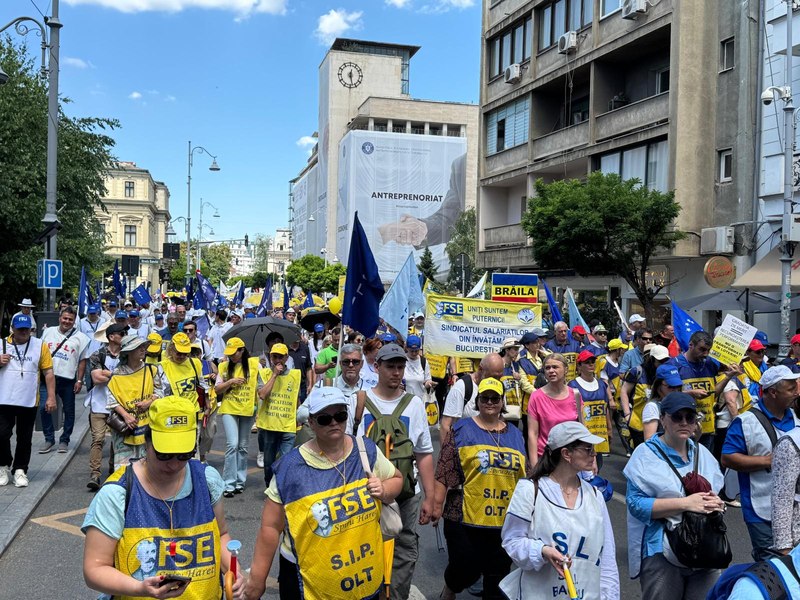
Romanian unions warn salary law could erase strike gains
Translated from Romanian, summarized and contextualized by DistantNews.
At a glance
News
Named sources
New plan
- Romanian education unions criticize the draft of the new unified salary law, warning it could annul benefits gained from the 2023 strike.
- Unions argue the law favors leadership positions and may freeze or reduce salaries for education and health workers.
- Prime Minister Ilie Bolojan seeks parliamentary approval for the law, aiming for a January 2027 effective date, but some parties disagree with accelerated adoption.
Romanian education unions are strongly opposing the proposed unified salary law, fearing it will strip teachers of benefits secured during the 2023 strike. Marius Nistor, president of the "Spiru Haret" Education Unions Federation, stated that if the bill passes as is, "everything we won in 2023 following our general strike could be annulled."
If we are to refer strictly to the education system, everything we won in 2023 following our general strike could be annulled if this unified salary law project were to pass.
Nistor further criticized the draft, asserting it disproportionately benefits dignitaries and management roles while potentially freezing or decreasing wages for essential workers in education and health. He highlighted that over 44% of these sector employees might see their income stagnate or shrink, with minimal increases for others. The proposed fixed amount for class teacher allowances, tied to a reference salary rather than a base salary percentage, could also reduce payments for experienced teachers by several hundred lei.
From my point of view, this will be a decision that will have to be adopted in Parliament and I believe that for Romania, honestly, the best formula is to adopt this unified salary law, with all its shortcomings, with all the dissatisfaction, as it will emerge from the dialogue and analysis of the European Commission.
Prime Minister Ilie Bolojan, however, is pushing for swift parliamentary adoption, even requesting an extraordinary session. He believes the law, despite its flaws and the dissatisfaction it generates, is the best path forward for Romania. He indicated the draft would be sent to parliamentary groups for consideration. Meanwhile, representatives from the PSD party have expressed that they have not yet seen the final version and oppose its accelerated passage.
For vital sectors of this country – Health, Education – over 44% of employees will have their incomes frozen or diminished, and for the rest, the increases are totally insignificant.
The new unified salary law is slated to take effect on January 1, 2027. The project aims to establish a ratio of 1:8 between the lowest and highest base salaries in the public sector, with a reference value of 4,100 lei set for 2027. Despite these provisions, education unions maintain that the current draft contains significant deficiencies and have vowed not to approve it without substantial modifications.
Most of my colleagues with seniority will have their class teacher allowance reduced by a few hundred lei.
DistantNews Editorial
Originally published by Adevărul in Romanian. Translated, summarized, and contextualized by our editorial team with added local perspective. Read our editorial standards.
More Stories

From Our Blog

What Gets Lost (and Found) When News Is Translated

The Critical Role of Diaspora Media in Global News

What Travellers Should Know About Countries with Restricted Press

A Digital Nomad's Guide to Following Local News

How the Same Story Looks Different in Different Countries
