


Saudi Arabia: Royal Orders Reconstitute Cabinet Under Crown Prince Mohammed bin Salman
Summarized and contextualized by DistantNews.
At a glance
News
Named sources
New plan
- Saudi Arabia, Türkiye, and Pakistan signed the "Makkah Agreement for Joint Defense" to establish strategic, political, and military mechanisms for cooperation.
- The pact aims to strengthen joint deterrence and defense coordination, treating an attack on one signatory as an attack on all.
- The agreement is open to other countries and emphasizes building sustainable defense capabilities rather than forming a closed bloc.
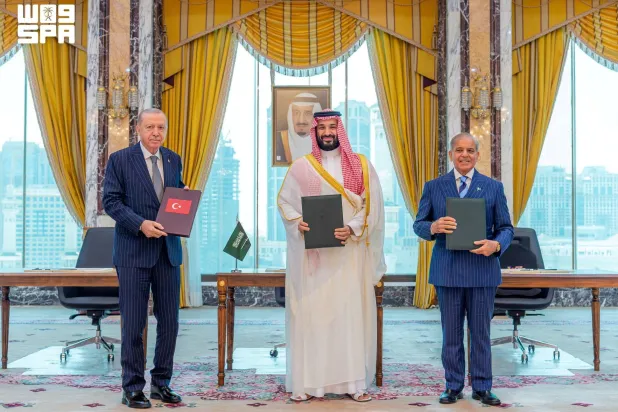
Saudi Arabia, Türkiye, and Pakistan have formalized a defense pact, the "Makkah Agreement for Joint Defense," aimed at establishing strategic, political, and military mechanisms for enhanced cooperation. Signed on August 7 during a summit in Makkah attended by Crown Prince Mohammed bin Salman, President Recep Tayyip Erdogan, and Prime Minister Shehbaz Sharif, the agreement seeks to bolster joint deterrence and defense coordination among the three regional powers.
Under the accord, strategic political and military mechanisms plan to be established involving the Defense Ministers, Foreign Ministers, and Chiefs of General Staff/Armed Forces Commanders, and that coordination among the three countries will be conducted at the highest level.
The core tenet of the pact is collective defense, stipulating that an armed attack against any one of the signatories will be considered an attack against all three. This framework is designed to strengthen the security of the participating nations and contribute to broader regional and international peace and stability. Saudi Defense Minister Prince Khalid bin Salman highlighted that the agreement establishes a long-term defense partnership, reinforcing deterrence and integration.
The agreement is aimed at strengthening joint deterrence, as well as defense coordination and integration among the three countries.
Türkiye's defense ministry stated that the pact's fundamental goal is to place defense and military ties on a more institutional and sustainable footing. Under the accord, senior ministers, including defense and foreign ministers, along with chiefs of staff, will coordinate at the highest level. This move signals a progression from political commitment to the establishment of practical structures for defense coordination, encompassing military, industrial, and technological cooperation.
It stipulates that an armed attack against any one of the parties will be considered an attack against all three, reinforcing the principle of collective defense against threats to their security.
Officials have stressed that the Makkah Agreement is not intended to form a closed military or sectarian bloc, nor is it linked to nuclear ambitions or an arms race. Turkish President Erdogan emphasized its openness to participation by all "brotherly countries" seeking regional peace and prosperity. Saudi officials further clarified that the focus is on building sustainable defense capabilities, with expansion dependent on establishing necessary institutional and regulatory mechanisms.
After the agreement was signed that it establishes a framework for a long-term defense partnership and strengthens deterrence, coordination and integration, contributing to regional and global security and stability.
DistantNews Editorial
Originally published by Asharq Al-Awsat. Summarized and contextualized by our editorial team with added local perspective. Read our editorial standards.
More Stories

From Our Blog

What Gets Lost (and Found) When News Is Translated

The Critical Role of Diaspora Media in Global News

What Travellers Should Know About Countries with Restricted Press

A Digital Nomad's Guide to Following Local News

How the Same Story Looks Different in Different Countries
