


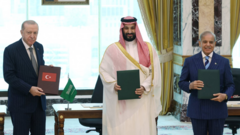
Saudi Arabia, Turkey and Pakistan sign defence pact
Summarized and contextualized by DistantNews.
At a glance
News
Sources not specified
New plan
- Saudi Arabia, Turkey, and Pakistan have signed a joint defense agreement, establishing mutual defense principles.
- The pact aims to strengthen collective deterrence, with an attack on one state considered an attack on all three.
- The agreement comes amid regional instability, particularly the conflict involving Iran and its allies, and aims to enhance defense cooperation among the three Sunni Muslim nations.
Saudi Arabia, Turkey, and Pakistan have formalized a joint defense agreement, a pact designed to bolster collective security and deter aggression. Announced following a meeting in Mecca between Saudi Crown Prince Mohammed bin Salman, Turkish President Recep Tayyip Erdogan, and Pakistani Prime Minister Shehbaz Sharif, the agreement stipulates that an armed attack against any one of the three signatory states will be regarded as an attack against all.
The pact emerges as the three nations seek to enhance security ties amidst escalating regional tensions, notably the ongoing conflict involving Iran and its proxies. The war has disrupted critical maritime traffic through the Strait of Hormuz and the Red Sea. Saudi Arabia and Pakistan had already signaled their intent for closer defense cooperation with a joint pact announced last year, but this new agreement deepens that commitment.
It further provides for the enhancement of all aspects of defence co-operation among the three States.
While the Mecca Joint Defence Agreement pledges mutual support among the three Sunni Muslim states, specific details regarding individual obligations remain undisclosed. A Turkish official characterized the pact as "purely defensive in nature." The alliance leverages the strengths of each nation: Saudi Arabia offers significant financial resources and is a major arms purchaser, Turkey contributes NATO's second-largest military force and advanced defense production capabilities, and Pakistan possesses nuclear weapons.
The three countries have voiced shared concerns over the Iran conflict's persistent nature and the broader repercussions across the region. Following recent attacks attributed to Iran and its allies on Saudi Arabia and other Gulf states, coupled with disruptions to shipping, the pact signals a unified front. Saudi Arabia, despite efforts to remain neutral, has engaged in joint strikes with the U.S. against Iranian proxy militias. Pakistan has played a role as an intermediary in ceasefire negotiations, though fighting has reignited.
purely defensive in nature
DistantNews Editorial
Originally published by BBC News. Summarized and contextualized by our editorial team with added local perspective. Read our editorial standards.
More Stories


From Our Blog

What Gets Lost (and Found) When News Is Translated

The Critical Role of Diaspora Media in Global News

What Travellers Should Know About Countries with Restricted Press

A Digital Nomad's Guide to Following Local News

How the Same Story Looks Different in Different Countries
