


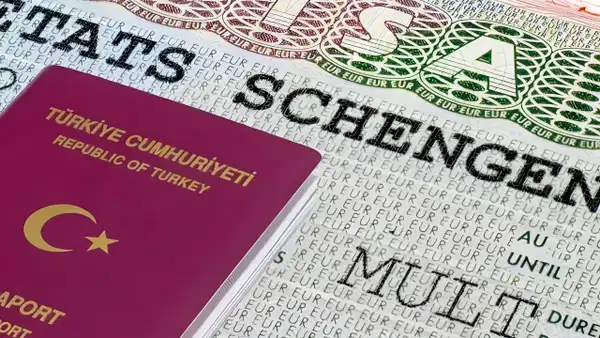
Schengen visa data for 2025: Greeks most popular, Germans reject most Turkish applicants
Translated from Turkish and summarized by DistantNews. Read the original for the full story.
At a glance
News
From a news agency
Context piece
- In 2025, Turkey submitted approximately 1.27 million Schengen visa applications, with a 14.6% rejection rate.
- Greece received the most applications from Turkish citizens, while Germany had a 21.1% rejection rate.
- Portugal had the lowest rejection rate at 3.5%, but received significantly fewer applications.
European Commission data for 2025 reveals that Turkish citizens submitted around 1.27 million Schengen visa applications, with an overall rejection rate of 14.6%. Greece emerged as the most sought-after destination among Turkish applicants, followed by Germany.
Germany processed 217,627 applications from Turkey, but rejected 21.1% of them. This rate is notably higher than the general average for Turkish Schengen applications and stands out among countries with substantial application volumes. The data, reported by T24, indicates a significant hurdle for Turkish nationals seeking entry into Germany.
Other countries also showed considerable rejection rates. Denmark rejected 19.19% of its 44,253 applications from Turkey, and Hungary rejected 18.14% of its 35,605 applications. France saw a 15.23% rejection rate from 143,379 applications, while Italy rejected 14.77% of its 79,470 applications.
Conversely, some Schengen countries had much lower rejection rates. The Netherlands rejected 9% of applications from Turkey, and Bulgaria rejected 10.1%. Spain and Romania both had a 7.4% rejection rate. Portugal recorded the lowest rejection rate at 3.5%, although it received a considerably smaller number of applications, just 3,921, from Turkey.
About this summary
Originally published by Cumhuriyet in Turkish. Translated, summarized, and contextualized automatically by DistantNews, with a note on how the source frames the story. Not individually reviewed before publishing. How this works.
More Stories



From Our Blog

What Gets Lost (and Found) When News Is Translated

The Critical Role of Diaspora Media in Global News

What Travellers Should Know About Countries with Restricted Press

A Digital Nomad's Guide to Following Local News

How the Same Story Looks Different in Different Countries
