


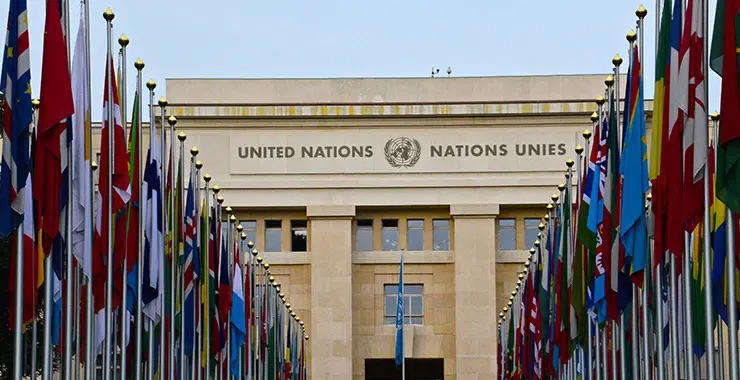
Selection process for next UN chief begins
Summarized and contextualized by DistantNews.
At a glance
News
Named sources
Ongoing story
- The UN Security Council has begun selecting the next secretary-general, holding an initial straw poll.
- Seven candidates, including four women, are vying to succeed Antonio Guterres, whose term ends December 31, 2026.
- The selection process is complex, with the five permanent members of the Security Council holding veto power.
The United Nations Security Council has initiated the selection process for its next secretary-general, commencing with a crucial "straw poll" to gauge support for the seven candidates. Among the contenders aiming to succeed Antonio Guterres, whose second five-year term concludes at the end of 2026, are four women and three men. The candidates represent diverse backgrounds, including Michelle Bachelet of Chile, Maria Fernanda Espinosa of Ecuador, Rafael Grossi of Argentina, Rebeca Grynspan of Costa Rica, Olara Otunnu of Uganda, Carolyn Rodrigues-Birkett of Guyana, and Macky Sall of Senegal.
It’s an important start to the process. It’s important (we) select the best candidate.
While Rafael Grossi, the current head of the International Atomic Energy Agency, possesses significant name recognition, observers suggest there is no clear frontrunner at this early stage. The process, which could extend for several months, is heavily influenced by the permanent members of the Security Council, the United States, Russia, China, France, and the United Kingdom. Their preferences remain undisclosed, making the outcome uncertain. "Your guess is as interesting as mine," remarked one senior diplomat, highlighting the unpredictability.
Your guess is as interesting as mine.
The selection hinges on securing at least nine votes from the 15 council members, crucially without facing a veto from any of the five permanent powers. This dynamic is particularly significant given the current geopolitical divisions among these major nations. Even if a candidate secures the necessary votes, a veto can halt their progress. Following the Security Council's decision, the nominated candidate must still be confirmed by the General Assembly, comprising all UN member states.
The straw polls may show that some candidates are just not viable, and allow them to bow out in a dignified manner.
The "straw poll" mechanism, designed to help candidates withdraw gracefully if they lack support, involves anonymous "encourage," "discourage," or "no opinion" labels. While initial ballots are indistinguishable, the ballots of the permanent members will eventually be color-coded to identify potential vetoes without revealing the specific country. This informal process, despite criticism regarding its opacity, has been a fixture in UN leadership selections since the early 1980s. Tradition also suggests the role should rotate geographically, potentially favoring a candidate from Latin America this time, given the region's representation among the hopefuls.
I would be surprised if any one candidate emerges with a decisive numerical advantage.
DistantNews Editorial
Originally published by Vanguard. Summarized and contextualized by our editorial team with added local perspective. Read our editorial standards.
More Stories


From Our Blog

How the Same Story Looks Different in Different Countries

What Gets Lost (and Found) When News Is Translated

The Critical Role of Diaspora Media in Global News

What Travellers Should Know About Countries with Restricted Press

A Digital Nomad's Guide to Following Local News
