

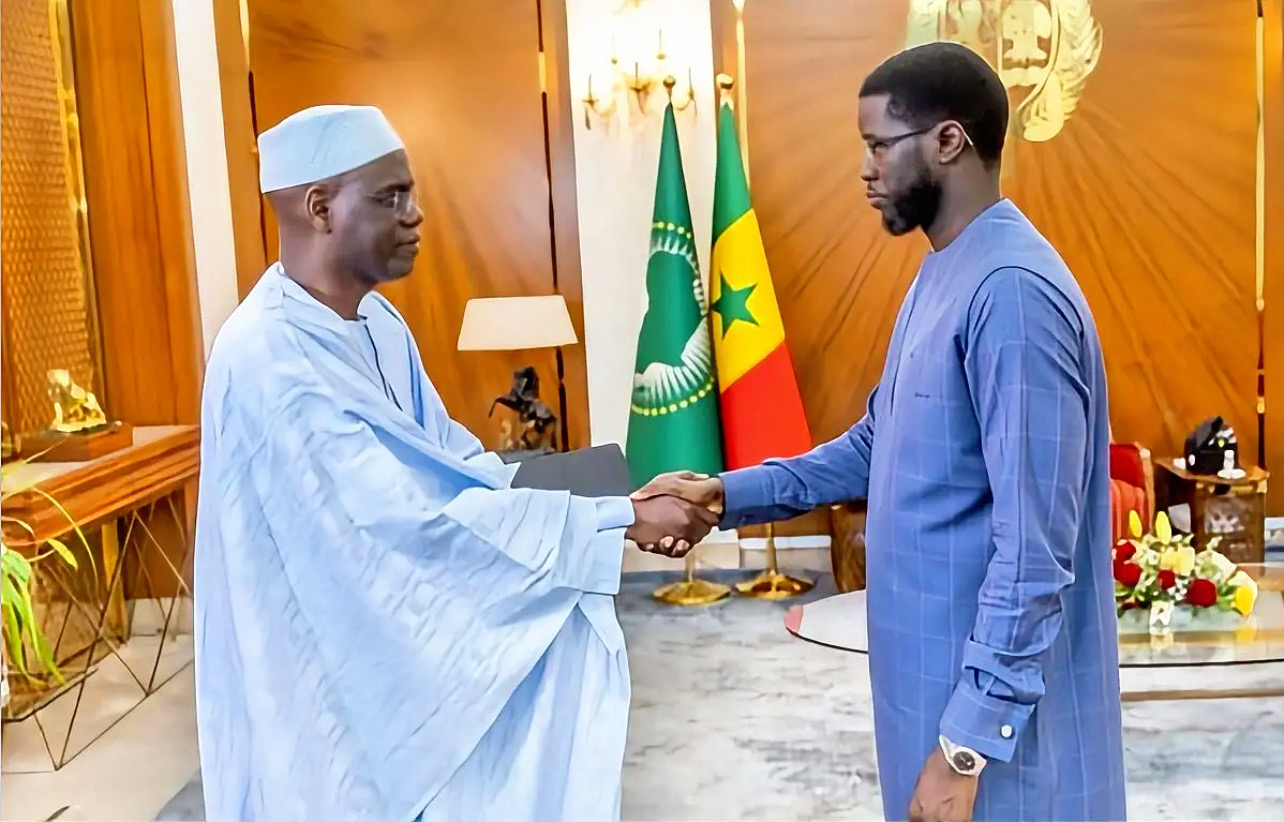
Senegal's New Government Reflects Power Shift Amidst Pastef Divisions
Translated from French, summarized and contextualized by DistantNews.
At a glance
News
Sources not specified
New plan
- Senegal's President Bassirou Diomaye Faye has appointed a new government led by Ahmadou Al Aminou Lô, signaling a shift towards technocratic profiles to address economic and social urgencies.
- Despite the ruling Pastef party's initial statement that it would not participate, several party members are now part of the new executive, highlighting internal divisions and a potential split between an institutional Pastef around the president and a militant Pastef loyal to Ousmane Sonko.
- This political duality risks institutional turbulence and a leadership rivalry that could jeopardize the party's ambitious project and Senegal's future, especially with the 2029 presidential election on the horizon.
Senegal's political landscape is undergoing a significant transformation following the appointment of a new government led by Ahmadou Al Aminou Lô. This move, occurring shortly after Ousmane Sonko's departure from the Prime Ministry, marks a concrete step in the state's political recomposition. President Bassirou Diomaye Faye appears to be prioritizing technocratic expertise to tackle pressing economic and social challenges.
The new 26-member cabinet, however, also reveals a complex political reality. While the ruling Pastef party initially announced its non-participation, several key figures have joined the executive. This contradiction points to growing internal dissent within the movement that came to power in 2024. The divergence between Faye and Sonko, though perhaps not yet irreparable, seems deep enough to suggest a de facto split.
This potential division could see an "institutional Pastef" coalescing around the president, while a "militant Pastef" remains loyal to its historical leader. Such a scenario would be detrimental not only to the party but also to Senegal, as competing legitimacy centers within the same political camp could usher in a period of significant institutional instability. The paradox is that both Faye and Sonko stand to lose considerably from an escalation, as open confrontation would weaken the political edifice they built over years of struggle.
Despite the risks, current dynamics seem to be pushing the protagonists toward an increasingly difficult-to-contain rivalry. The 2029 presidential election looms, and Faye might be tempted to consolidate his political base using constitutional levers, such as dissolving the National Assembly to secure a more favorable majority for his actions and future ambitions. This potential power struggle could define the nation's immediate future.
DistantNews Editorial
Originally published by Le Pays in French. Translated, summarized, and contextualized by our editorial team with added local perspective. Read our editorial standards.
More Stories


From Our Blog

What Gets Lost (and Found) When News Is Translated

The Critical Role of Diaspora Media in Global News

What Travellers Should Know About Countries with Restricted Press

A Digital Nomad's Guide to Following Local News

How the Same Story Looks Different in Different Countries
