


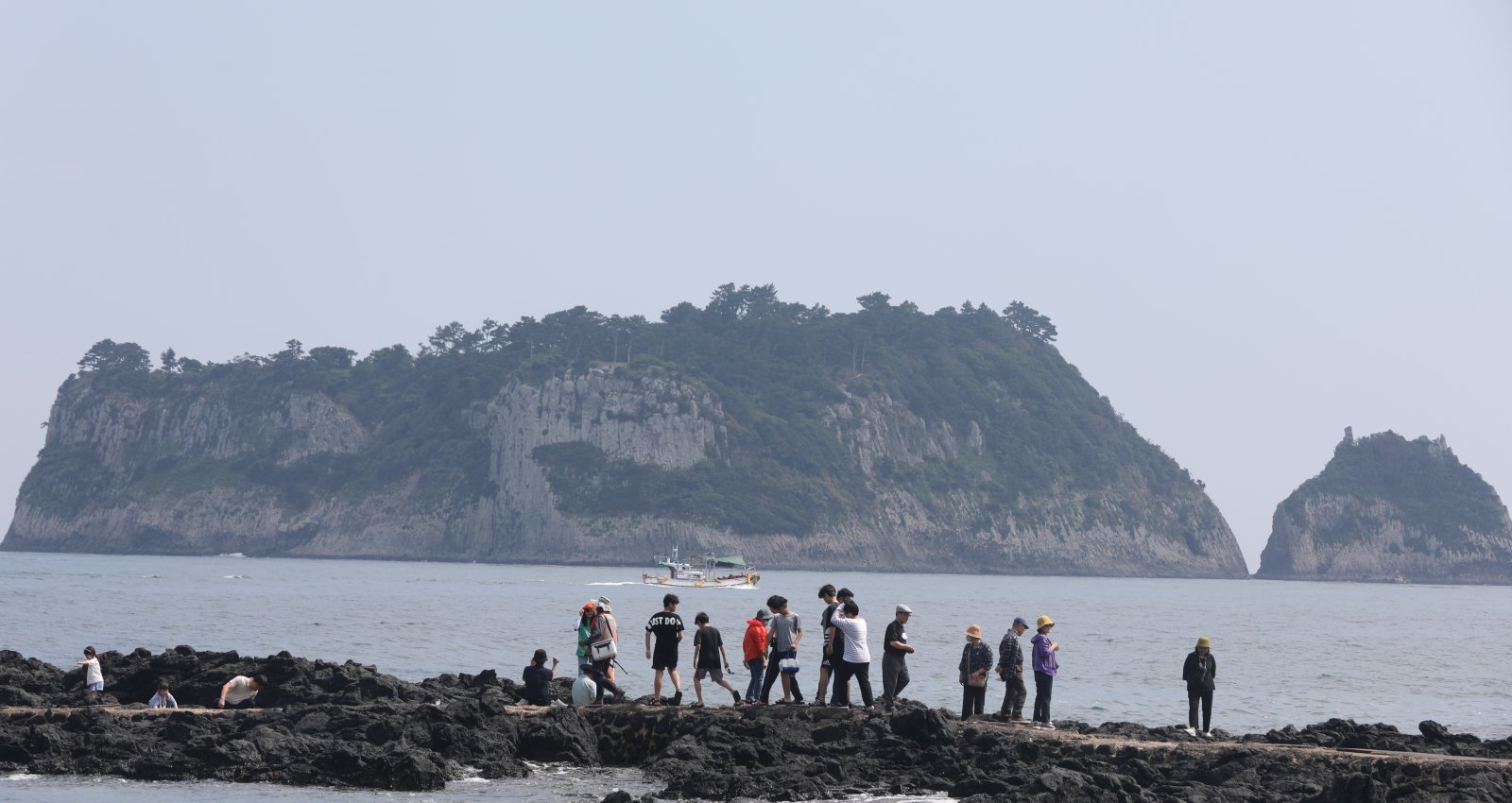
Seogwipo's Beomseom, Munseom, and Seopseom islands formed around 800,000 years ago, suggesting linear volcanic activity
Translated from Korean, summarized and contextualized by DistantNews.
At a glance
News
Sources not specified
Context piece
- Jeju World Heritage Center identified that three volcanic islands off the coast of Seogwipo, Beomseom, Munseom, and Seopseom, formed around 800,000 years ago.
- The islands' linear arrangement suggests a potential volcanic eruption along a single fissure in southern Jeju.
- This finding, using advanced dating techniques, will enhance the accuracy of Jeju's volcanic activity history and provide foundational data for explaining its natural heritage formation.
Three volcanic islands off the coast of Seogwipo, namely Beomseom, Munseom, and Seopseom, have been found to have formed around 800,000 years ago, according to Jeju World Heritage Center. The islands' alignment in a near-straight line has led to the hypothesis that volcanic activity may have occurred along a single fissure in southern Jeju.
This discovery stems from the ongoing "Jeju Island Geological Map Construction Project," initiated in 2025. While previous dating methods suggested Munseom and Seopseom formed around 730,000 years ago, the World Heritage Center employed more precise Argon-Argon (Ar-Ar) dating. The analysis revealed Beomseom formed 804,000 years ago (±4,000 years), Munseom 824,000 years ago (±8,000 years), and Seopseom 796,000 years ago (±3,000 years).
The key finding is that all three islands formed within a narrow timeframe of approximately 800,000 years ago and are arranged linearly. This suggests the possibility of "linear volcanic activity" occurring in the southern sea of Jeju. Further analysis of rock and mineral chemical compositions will determine if the volcanic activity was linked to a single or similar magma supply system.
The results are expected to improve the accuracy of Jeju's volcanic activity history and serve as crucial data for scientifically explaining the formation of Jeju's natural heritage. This work builds upon previous efforts to compile eruption timing data for about 90 volcanic cones on Jeju.
DistantNews Editorial
Originally published by Dong-A Ilbo in Korean. Translated, summarized, and contextualized by our editorial team with added local perspective. Read our editorial standards.
More Stories


From Our Blog

What Gets Lost (and Found) When News Is Translated

The Critical Role of Diaspora Media in Global News

What Travellers Should Know About Countries with Restricted Press

A Digital Nomad's Guide to Following Local News

How the Same Story Looks Different in Different Countries
