


Shared Rivers: North Korea's Border Fortifications Pose Water Security Threat to South Korea
Translated from Korean, summarized and contextualized by DistantNews.
At a glance
Analysis
Sources not specified
Context piece
- North Korea is fortifying its border with South Korea, creating a heavily guarded 'impenetrable fortress' with walls, fences, and minefields.
- Despite the border fortifications, shared rivers like the Imjin and Bukhan rivers flow from North to South, posing a potential security and water resource issue for South Korea.
- The article highlights the critical importance of these rivers for South Korea's water-stressed population and its semiconductor industry, warning of potential disruptions if North Korea restricts water flow.
North Korea is transforming its border with South Korea into an "impenetrable fortress," according to reports detailing extensive fortifications. Following leader Kim Jong Un's directive to create a "fortress-like national border," North Korean troops are erecting barriers and fences, even in intense heat. A completed section of the border in Goseong, Gangwon Province, exemplifies this, featuring a 5-meter high wall, seven layers of barbed wire including high-voltage lines, detection wires, and minefields, creating a formidable ten-layered defense.
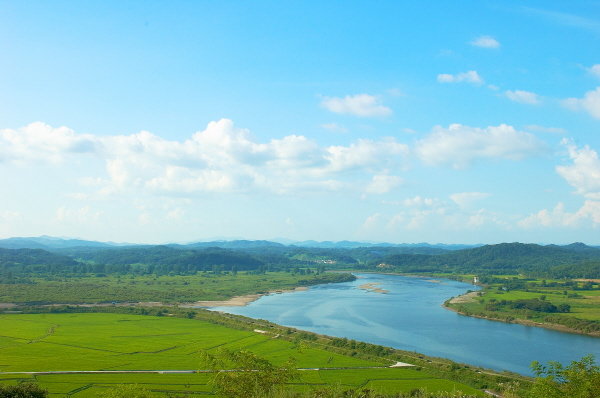
Despite these stringent physical barriers, a significant flow of water continues from North to South through shared rivers. The Imjin River and the Bukhan River are the two major shared waterways, with numerous tributaries also originating in the North. This natural connection raises concerns for South Korea, a nation already grappling with water scarcity due to its high population density and concentrated rainfall patterns.
South Korea faces significant water stress, ranking third globally among countries with populations over 10 million in terms of population density. The nation's reliance on concentrated summer rainfall makes water management challenging. This is further compounded by the burgeoning semiconductor industry's immense water needs; producing a single 12-inch semiconductor wafer requires seven tons of ultrapure water.
The article specifically focuses on the Imjin River, of which 63% of its basin lies in North Korea. This geographical reality means South Korea cannot unilaterally manage the river's water resources. North Korea has constructed seven dams on the upper Imjin River and completed a diversion tunnel in 2008 to redirect water to the East Sea for power generation, effectively making that water inaccessible to South Korea. While North Korea sometimes releases water from its Hwanggang dam during the rainy season, potentially causing floods, it can also restrict flow during drier periods, severely impacting water availability for agriculture and industry in the northern regions of South Korea.
The Imjin River, once a vital waterway supporting navigation and abundant water supply, is now significantly diminished. The article points to the Yeoncheon Gunnam Dam and Hantan River Dam in South Korea as crucial for maintaining water levels, especially for agricultural use in the spring. However, the Hantan River's flow is also vulnerable if North Korea further obstructs its upstream tributaries. The situation underscores a critical vulnerability for South Korea's water security and industrial needs, directly linked to North Korea's water management decisions.
DistantNews Editorial
Originally published by Dong-A Ilbo in Korean. Translated, summarized, and contextualized by our editorial team with added local perspective. Read our editorial standards.
More Stories


From Our Blog

What Gets Lost (and Found) When News Is Translated

The Critical Role of Diaspora Media in Global News

What Travellers Should Know About Countries with Restricted Press

A Digital Nomad's Guide to Following Local News

How the Same Story Looks Different in Different Countries
