


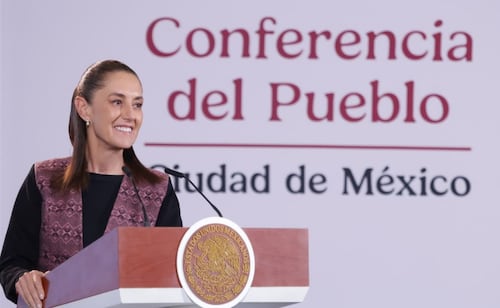

Sheinbaum says Mexico’s electoral bodies must set rules for social media campaigning
Translated from Spanish and summarized by DistantNews. Read the original for the full story.
At a glance
News
Named sources
Context piece
- President Claudia Sheinbaum said Mexico’s National Electoral Institute and Electoral Tribunal should establish rules and limits for electoral propaganda on social media in the 2027 elections.
- Sheinbaum said the autonomous electoral institute organizes elections, while the tribunal ultimately validates them.
- She emphasized that Mexican citizens, rather than a private company, count the votes at polling stations.
President Claudia Sheinbaum said Mexico’s electoral authorities, not the executive branch, should define the limits of political advertising on social media ahead of the 2027 elections.
Who organizes the elections is the National Electoral Institute, it is an autonomous institution, and who ultimately validates the election is the Electoral Tribunal, and they have to define the rules and characteristics of social media propaganda.
Speaking at her morning news conference at the National Palace, Sheinbaum said the National Electoral Institute, known as INE, organizes elections and that the Electoral Tribunal of the Federal Judiciary, or TEPJF, ultimately validates them. Those institutions, she said, must determine the rules and characteristics governing online electoral propaganda.
“From my perspective, it is the National Electoral Institute, as always, that should define at least the limits in terms of propaganda,” Sheinbaum said.
From my perspective, it is the National Electoral Institute, as always, that should define at least the limits in terms of propaganda.
She also contrasted Mexico’s voting system with Colombia’s, where votes are counted by a private company, according to her remarks. “In Mexico, it is the citizens who count the votes,” she said, adding that Mexicans agree the INE should continue organizing elections and that polling-station representatives should count the ballots.
In Mexico, it is the citizens who count the votes.
About this summary
Originally published by El Universal in Spanish. Translated, summarized, and contextualized automatically by DistantNews, with a note on how the source frames the story. Not individually reviewed before publishing. How this works.
More Stories

From Our Blog

What Press Freedom Means for the News You Read

News in Translation: What Gets Lost, and How We Keep the Framing

Diaspora Media: How Communities Follow News From Home

Traveling Where the Press Is Not Free: How to Read the News There

The Digital Nomad's Guide to Local News
