


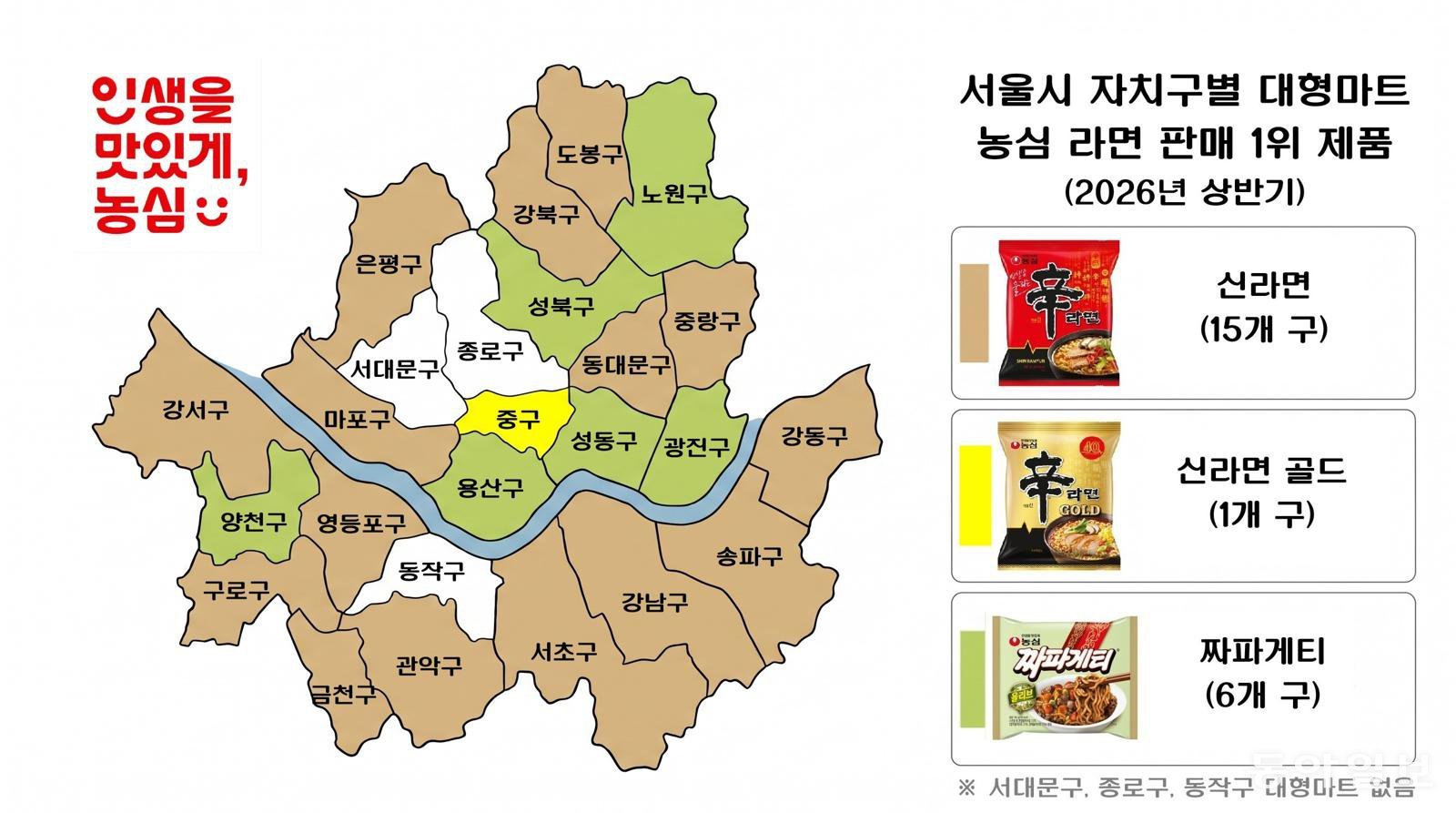
Shin Ramyun Tops Sales in 15 Seoul Districts, Chapagetti Leads in Six
Translated from Korean, summarized and contextualized by DistantNews.
At a glance
News
Sources not specified
Context piece
- Nongshim has released its 'Seoul Ramen Popularity Map' based on sales data from major supermarkets and SSMs across Seoul's 25 districts in the first half of the year.
- Shin Ramyun was the top-selling Nongshim ramen overall and in 15 districts, but Chapagetti outsold it in six districts, particularly those with many families or young professionals.
- In tourist areas like Myeongdong, Shin Ramyun Gold and Shin Ramyun Tumbah led sales, reflecting demand for K-food souvenirs, while Shin Ramyun dominated SSM sales across all districts.
Nongshim has unveiled its 'Seoul Ramen Popularity Map,' a detailed analysis of its noodle sales across Seoul's 25 districts in the first half of 2026. The report reveals that Shin Ramyun remains the overall top seller in major supermarkets across the capital. However, the beloved instant noodle faced a surprising challenge in six districts, where Chapagetti, another Nongshim product, claimed the top spot.
The company attributes these regional variations to demographic and lifestyle differences. In districts like Yangcheon and Nowon, characterized by family-oriented households and large apartment complexes, Chapagetti's popularity suggests it's a favored choice for family meals or occasional treats. Conversely, in areas with a higher concentration of young professionals and university students, such as Seongbuk and Yongsan, Chapagetti's appeal might stem from its versatility in various 'modi-sumeo' (creative) recipes.
The regional preference for ramen showed differences depending on the local population composition, commercial area, and distribution channel.
In the bustling tourist hubs of Jung-gu, including Myeongdong and Seoul Station, Nongshim's global strategy products, Shin Ramyun Gold and Shin Ramyun Tumbah, took the lead. This indicates a strong demand for K-food souvenirs among international visitors. Meanwhile, Shin Ramyun maintained its dominance in neighborhood supermarkets (SSMs) across all 25 districts, a trend Nongshim attributes to consumers' preference for familiar, trusted brands for everyday grocery items.
Nongshim stated that the varying preferences highlight the influence of local demographics, commercial areas, and distribution channels on ramen consumption. The company pledged to continue developing diverse products tailored to consumers' lifestyles and tastes.
We will continue to introduce various products tailored to consumers' lifestyles and tastes.
DistantNews Editorial
Originally published by Dong-A Ilbo in Korean. Translated, summarized, and contextualized by our editorial team with added local perspective. Read our editorial standards.
More Stories



From Our Blog

What Gets Lost (and Found) When News Is Translated

The Critical Role of Diaspora Media in Global News

What Travellers Should Know About Countries with Restricted Press

A Digital Nomad's Guide to Following Local News

How the Same Story Looks Different in Different Countries
