


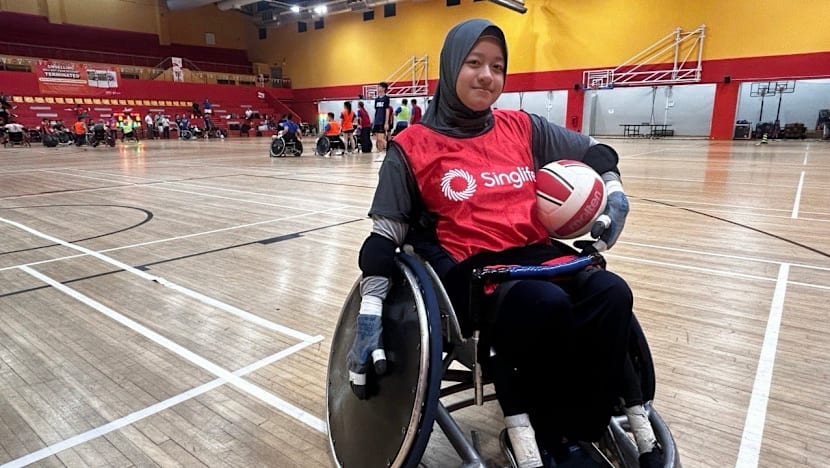
Singapore's sole female national wheelchair rugby player, once excluded from sports, now thrives on the court
Translated from English and summarized by DistantNews. Read the original for the full story.
At a glance
In-depth
Sources not specified
Context piece
- Nur Sabrina Suhaimi is Singapore's only female national wheelchair rugby player, a sport known for its physicality.
- She navigates daily life with a rare genetic disorder causing muscle weakness and loss of sensation, requiring mobility aids.
- Despite early exclusion from sports due to her condition, Sabrina now excels in wheelchair rugby, embracing its intense nature.
Wheelchair rugby, once grimly known as "murderball," is a high-impact sport where players collide as they fight to score. For 25-year-old Nur Sabrina Suhaimi, Singapore's only female national player in the sport, these collisions are an exhilarating part of the game. "It's like bumper cars – exhilarating. It is a game where you can unleash your madness in a legal way," she laughs.
It’s like bumper cars – exhilarating. It is a game where you can unleash your madness in a legal way.
Sabrina lives with Charcot-Marie-Tooth disease, a rare genetic neurological disorder that progressively damages peripheral nerves, leading to muscle weakness and loss of sensation. Her fingers curl inward, making gripping difficult, and she requires a walking cane and ankle-foot orthoses to walk short distances. Yet, when she transitions to her specialized rugby wheelchair, she transforms into a formidable athlete, flying across the court.
Her journey to the sport was not straightforward. Growing up, Sabrina was not athletic and began experiencing mobility issues at a young age. By secondary school, climbing stairs became challenging, and her physiotherapist advised her to avoid physical education classes for safety. "I thought I couldn’t do sports anymore, and that made me feel like I was different from others," she recalled.
I like that wheelchair rugby used to be called murderball. I like that it sounds scary.
It was only at age 16, after her condition progressed to affect her hands, that doctors diagnosed her with Charcot-Marie-Tooth disease. This diagnosis finally provided an explanation for years of unexplained physical challenges. Initially, male teammates were gentler with her, but her fierce play quickly changed their perception. "Recently, we had a tournament, and I kept banging into my opponent. He told me that I own this court," she recounted with a laugh.
I thought I couldn’t do sports anymore, and that made me feel like I was different from others.
Sabrina's story is one of overcoming physical limitations to find empowerment and belonging in a demanding sport. Her passion for wheelchair rugby, even embracing its intimidating nickname, highlights her resilience and determination.
Recently, we had a tournament, and I kept banging into my opponent. He told me that I own this court.
About this summary
Originally published by CNA in English. Translated, summarized, and contextualized automatically by DistantNews, with a note on how the source frames the story. Not individually reviewed before publishing. How this works.
More Stories


From Our Blog

What Gets Lost (and Found) When News Is Translated

The Critical Role of Diaspora Media in Global News

What Travellers Should Know About Countries with Restricted Press

A Digital Nomad's Guide to Following Local News

How the Same Story Looks Different in Different Countries
