


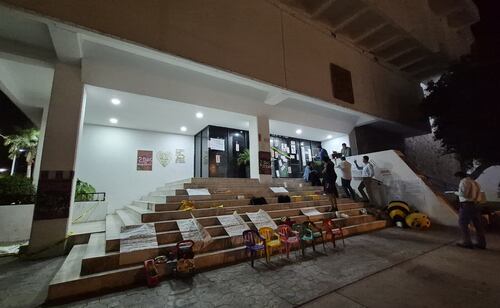
Sonora Congress session sparks outrage: Morena accused of excluding opposition in late-night vote
Translated from Spanish, summarized and contextualized by DistantNews.
TLDR
- A late-night legislative session in Sonora, Mexico, has sparked a political conflict between the ruling Morena party and opposition factions.
- Opposition legislators from Movimiento Ciudadano and the PRI claim they were excluded from the session where key reforms to the internal functioning of the State Congress were approved.
- The approved reforms allow the Congress to convene in alternate locations indefinitely under certain conditions and address issues like feminicide, while opposition parties denounce the process as undemocratic.
El Universal reports on a contentious late-night session in the Sonora State Congress that has ignited a fierce political dispute. The majority Morena party pushed through significant reforms concerning the internal operations of the legislature, but opposition parties, including Movimiento Ciudadano and the PRI, allege they were deliberately excluded from the proceedings. This incident highlights a recurring pattern of political maneuvering that often sidelines dissenting voices in Mexico's state-level politics.
The core of the conflict lies in the opposition's accusation that Morena and its allies restricted access to the legislative chamber, effectively barring them from participating with voice and vote. This occurred during a session that was rescheduled after a protest by representatives of childcare facilities demanding funds. The opposition views this exclusion as a violation of their political and electoral rights, vowing to pursue legal action to restore constitutional order.
Our political-electoral rights were violated by preventing us from participating with voice and vote in an ordinary session.
Among the reforms passed was a measure allowing the Congress to hold sessions in alternate locations indefinitely when the official venue is unusable. Additionally, changes were made to empower the Internal Regime and Political Concertation Commission to determine venue changes without a full floor vote. A constitutional reform related to feminicide, aligning national penalties, was also approved. While the Congress defended the session's legality, citing the need to ensure legislative continuity amid extraordinary circumstances, the opposition has decried the process as "clandestine" and a betrayal of democratic principles. This event underscores the deep partisan divisions and the intense political battles that characterize governance in many Mexican states.
giving its back to democracy
DistantNews Editorial
Originally published by El Universal in Spanish. Translated, summarized, and contextualized by our editorial team with added local perspective. Read our editorial standards.
More Stories


From Our Blog

What Press Freedom Means for the News You Read

What Gets Lost (and Found) When News Is Translated

The Critical Role of Diaspora Media in Global News

What Travellers Should Know About Countries with Restricted Press

A Digital Nomad's Guide to Following Local News
