


South Korea's finance and education ministries clash over education grant reforms
Translated from Korean, summarized and contextualized by DistantNews.
At a glance
News
Named sources
Context piece
- South Korea's Ministry of Economy and Finance and the Ministry of Education are publicly debating reforms to the local education finance grant system.
- The finance ministry advocates for structural changes due to declining student populations, while the education ministry seeks to maintain the current framework and expand its scope.
- The debate centers on whether to adjust the grant, which is automatically linked to 20.79% of national taxes, to better manage limited resources and address new educational demands.
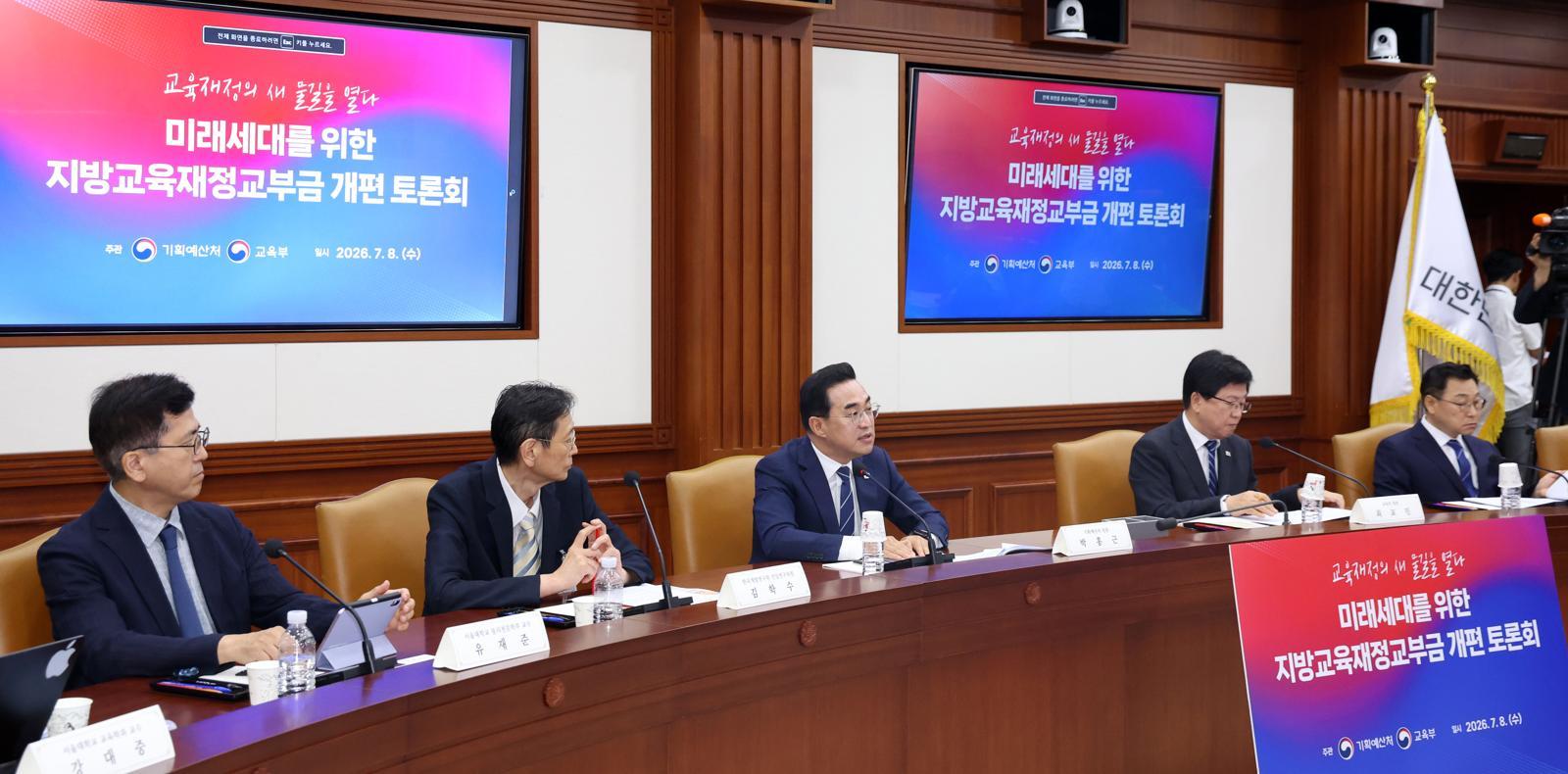
A public debate has erupted between South Korea's Ministry of Economy and Finance and the Ministry of Education over proposed reforms to the local education finance grant system, a mechanism that has been in place for over 50 years. The core of the disagreement lies in how to adapt the system, which automatically allocates 20.79% of national taxes to education, to the reality of a declining student population.
The current system's sustainability and ways to effectively utilize limited resources need to be reviewed.
Finance Minister Park Hong-keun argues for a structural overhaul, citing the system's volatility due to fluctuations in tax revenue and questioning its long-term sustainability. He emphasized the need to explore ways to effectively utilize limited financial resources. The finance ministry's stance is that the current automatic allocation, likened to a direct debit by some experts, needs to be re-evaluated in light of increasing national debt and future burdens on younger generations.
It is concerning to approach this with a one-sided economic logic that suggests budgets should be reduced simply because the student population has decreased.
Conversely, Education Minister Choi Kyo-jin expressed concern over a purely economic approach to education funding. While agreeing on the need for rational reform in response to falling student numbers, he cautioned against simply reducing budgets based on enrollment figures. The education ministry proposes maintaining the 20.79% framework as a baseline while exploring ways to expand its application to higher education, early childhood education, and lifelong learning to meet evolving educational needs.
If the current structure is maintained, the burden on future generations will snowball, considering the increase in national debt.
The discussion also involves regional education leaders. The president of the Korean Association of Superintendents of Education warned that altering the 20.79% allocation would face historical and social criticism, arguing that reallocating funds from primary and secondary education to meet new demands is inappropriate. Experts at the debate presented differing views, with some supporting the finance ministry's call for fiscal prudence and others backing the education ministry's emphasis on addressing new educational demands like supporting multicultural students and digital transformation.
If the Lee Jae-myung administration reduces the 20.79% [allocation], it will face historical and social judgment.
DistantNews Editorial
Originally published by Dong-A Ilbo in Korean. Translated, summarized, and contextualized by our editorial team with added local perspective. Read our editorial standards.
More Stories


From Our Blog

What Gets Lost (and Found) When News Is Translated

The Critical Role of Diaspora Media in Global News

What Travellers Should Know About Countries with Restricted Press

A Digital Nomad's Guide to Following Local News

How the Same Story Looks Different in Different Countries
