


South Korea's industrial production falls 0.3% in May amid semiconductor slump
Translated from Korean, summarized and contextualized by DistantNews.
At a glance
News
Sources not specified
Context piece
- South Korea's industrial production decreased by 0.3% in May, marking the second consecutive month of decline.
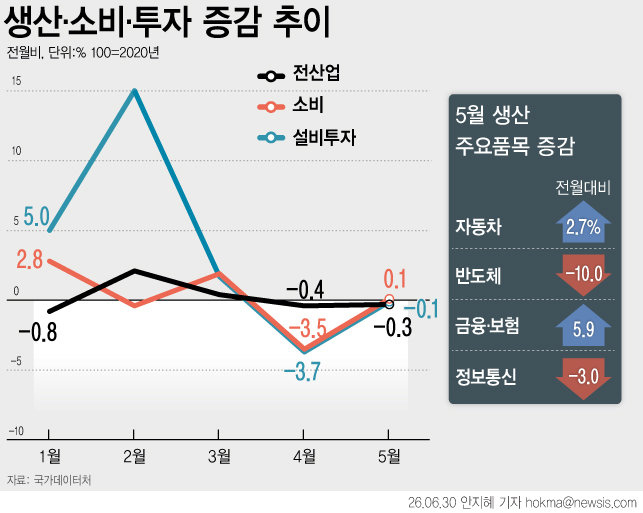
- Semiconductor production fell sharply by 10.0%, contributing to a 3.0% drop in manufacturing output.
- While consumption saw a slight increase, investment in facilities declined, and the coincident economic index turned negative for the first time in five months.
South Korea's industrial production experienced a downturn in May, contracting by 0.3% and marking the second consecutive month of decline. The manufacturing sector, a key driver of the nation's economy, showed weakness, largely due to a significant 10.0% drop in semiconductor production.
Overall manufacturing and mining output fell by 3.0%. While production of automobiles and petroleum refining saw increases, the substantial decrease in semiconductors and a 17.5% decline in pharmaceutical production weighed heavily on the sector. This led to a 2.4% decrease in manufacturing shipments, both domestically and for export, and a rise in inventory levels.
Semiconductors are in the process of adjusting production volume as they reach the limit of their production capacity. After hitting a peak index last September, fluctuations have been repeated.
Consumption, however, showed a slight improvement, with retail sales increasing by 0.1% after a sharp decline in April. This was driven by increased sales of non-durable goods and semi-durable goods, although sales of durable goods, such as passenger cars, decreased. Facility investment continued its downward trend, falling by 0.1% for the second month in a row.
Adding to the concerns, the coincident economic index, which reflects current economic conditions, fell by 0.3 percentage points in May. This marks the first negative turn for the index since December, signaling a potential slowdown. However, the leading economic index, which forecasts future economic trends, rose for the 16th consecutive month, suggesting a potential recovery ahead. The government anticipates an improvement in key economic indicators following the signing of a memorandum of understanding to end the conflict in the Middle East, which has led to a significant drop in international oil prices.
There are some adjustments being made according to delivery contract schedules, and it appears there is also an effect of reduced volume due to the continued rise in semiconductor prices. However, we believe the fundamentals of semiconductors are solid. If new fabs currently under construction are put into operation, we expect an increase in volume as well.
DistantNews Editorial
Originally published by Dong-A Ilbo in Korean. Translated, summarized, and contextualized by our editorial team with added local perspective. Read our editorial standards.
More Stories

From Our Blog

What Gets Lost (and Found) When News Is Translated

The Critical Role of Diaspora Media in Global News

What Travellers Should Know About Countries with Restricted Press

A Digital Nomad's Guide to Following Local News

How the Same Story Looks Different in Different Countries
