


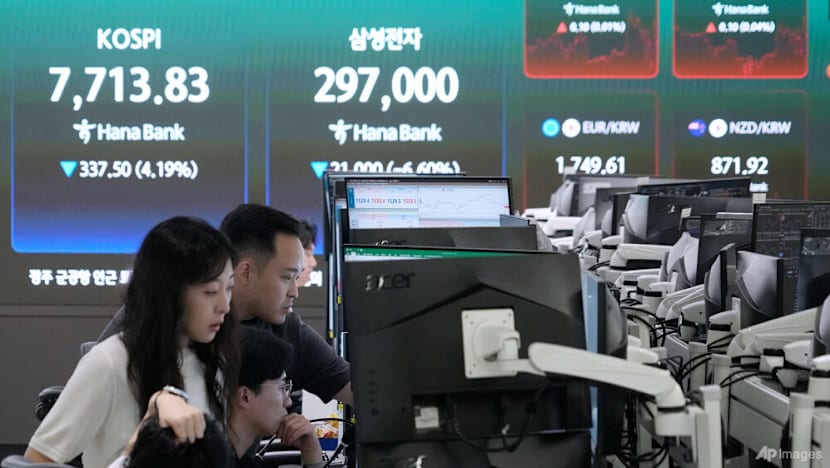
South Korea's KOSPI tumbles 8%, triggering circuit breakers for sixth time this year
Summarized and contextualized by DistantNews.
At a glance
News
Named sources
Context piece
- South Korea's benchmark KOSPI index plummeted 8.03% on Tuesday, triggering circuit breakers for the sixth time this year.
- The sharp decline occurred despite Samsung Electronics forecasting a 19-fold jump in its second-quarter operating profit.
- Investors are concerned that strong earnings, particularly in AI-related chip stocks, may already be fully priced into the market, leading to profit-taking and increased volatility.
South Korean shares experienced a significant downturn on Tuesday, with the benchmark KOSPI index falling 8.03% and triggering trading halts for the sixth time this year. The sell-off was led by chipmakers, as investors grappled with concerns about the sustainability of record earnings driven by artificial intelligence.
The KOSPI was down 646.85 points at 7,404.48 as of 4:53 GMT. Trading was halted for 20 minutes after circuit breakers were activated. This marks the 12th time in history the index has seen such a measure, highlighting the heightened volatility in semiconductor stocks.
Even Samsung Electronics, a global leader in chip manufacturing, saw its shares drop 9.75%. This occurred despite the company forecasting a remarkable 19-fold increase in its second-quarter operating profit. Analysts suggest that the market's expectations have become excessively high, leading to worries that current earnings levels may not be sustained.
It is good news but can't be interpreted entirely as good news, as market expectations have grown too high to be raised further, fanning worries that high earnings will not be sustained.
Peer chipmaker SK Hynix also experienced a substantial drop of 10.58%. The negative sentiment extended to Japan, where chip stocks, including memory chip maker Kioxia, fell sharply. Analysts attribute the volatility to a combination of profit-taking demand and persistent discussions surrounding AI and its impact on the chip sector.
While Samsung Electronics and SK Hynix have driven the KOSPI's rally this year, with gains exceeding 130% and 220% respectively, Tuesday's losses underscore investor caution. Other major index components also declined, including LG Energy Solution, which anticipates a 77% decrease in operating profit due to weak electric-vehicle demand, and Hanwha Ocean, which plunged over 24% after losing a significant submarine contract bid.
Although there is no issue when it comes to the chip sector's fundamentals, such as earnings, there remains demand for profit-taking, while noises regarding AI and the chip sector are being raised again and again, raising market volatility.
DistantNews Editorial
Originally published by CNA. Summarized and contextualized by our editorial team with added local perspective. Read our editorial standards.
More Stories


From Our Blog

What Gets Lost (and Found) When News Is Translated

The Critical Role of Diaspora Media in Global News

What Travellers Should Know About Countries with Restricted Press

A Digital Nomad's Guide to Following Local News

How the Same Story Looks Different in Different Countries
