


South Korea's Won Weakens Despite Current Account Surplus Amidst Rise in Private Overseas Investment
Translated from Korean, summarized and contextualized by DistantNews.
TLDR
- South Korea's current account surplus is not leading to won appreciation as traditionally expected, due to structural changes in the external sector.
- Increased private overseas investment and shifts in capital outflow structures are cited as primary reasons for the weakening correlation between the current account and the won's value.
- The Bank of Korea report highlights a transition from 'commodity shocks' to 'financial shocks' as the main driver of exchange rate fluctuations since 2015.
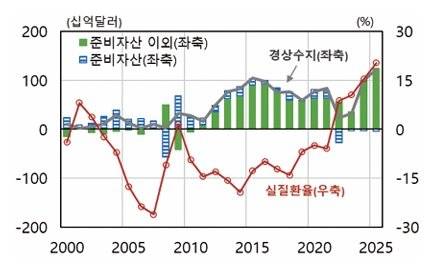
A recent report from the Bank of Korea reveals a significant shift in South Korea's economic landscape, challenging long-held assumptions about the relationship between the current account balance and the won's exchange rate. Traditionally, a surplus in the current account, driven by strong exports, would naturally lead to an appreciation of the Korean won. However, this traditional 동조화 (synchronization) is weakening, prompting analysis into the underlying structural changes.
Our external sector has undergone a major transformation since the 2000s, and unlike in the past, the trend is that a current account surplus does not directly lead to won appreciation.
The key factor identified is the substantial increase in private overseas investment. As South Korea transitions from being a net debtor to a net asset holder, its residents are actively investing abroad, primarily in foreign securities. This capital outflow, driven by individuals and corporations seeking higher returns or diversification, counteracts the inflow of foreign currency from exports. Consequently, even with a healthy trade surplus, the won is not strengthening as anticipated, creating a complex scenario for policymakers and businesses.
Since 2015, the frequency of real exchange rate appreciation due to capital outflows has increased.
This phenomenon underscores a broader economic evolution, mirroring trends seen in more developed economies. The report points to a shift in the primary drivers of exchange rate volatility, moving from 'commodity shocks'—related to trade in goods—to 'financial shocks,' which encompass capital flows and investment decisions. This implies that managing the exchange rate now requires a deeper understanding of private sector financial behavior and global investment trends, rather than solely focusing on trade performance. The implications for economic stability and policy are profound, necessitating a more nuanced approach to managing capital flows and ensuring financial market depth.
The demand for dollar assets has significantly increased, particularly among individuals, following the COVID-19 pandemic, leading to a surge in overseas stock investments.
DistantNews Editorial
Originally published by Dong-A Ilbo in Korean. Translated, summarized, and contextualized by our editorial team with added local perspective. Read our editorial standards.
More Stories


From Our Blog

What Gets Lost (and Found) When News Is Translated

The Critical Role of Diaspora Media in Global News

What Travellers Should Know About Countries with Restricted Press

A Digital Nomad's Guide to Following Local News

How the Same Story Looks Different in Different Countries
