


South Korea to expand mobile electronic certification services by 2026
Translated from Korean, summarized and contextualized by DistantNews.
At a glance
News
Official statement
New plan
- South Korea is expanding its mobile electronic certification services to public, financial, real estate, medical, and legal sectors by 2026.
- These services allow users to send and receive legally certified documents via smartphone, with records of delivery, viewing, and storage, aiding in dispute resolution.
- The initiative aims to reduce costs and improve efficiency compared to traditional paper-based certifications, with examples including land compensation notices and lease disputes.
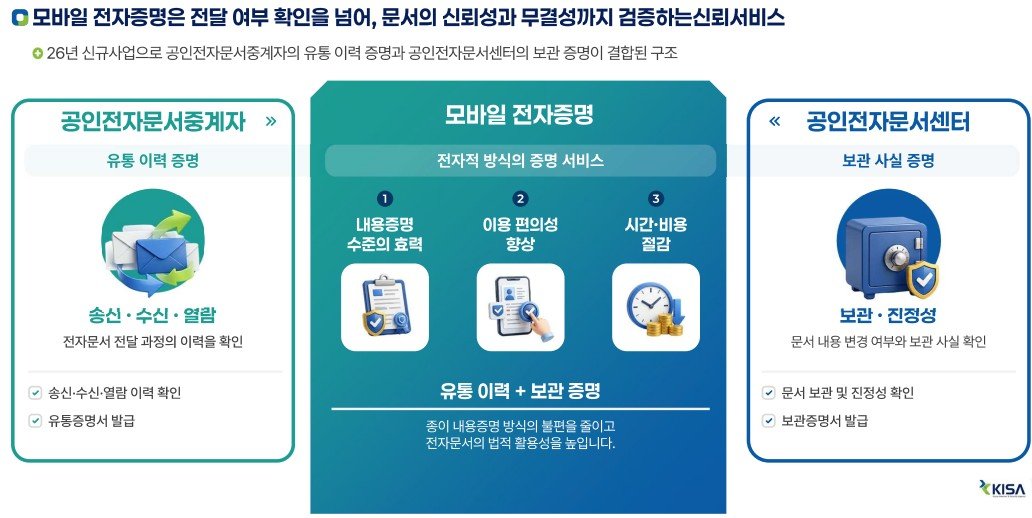
South Korea is set to significantly expand its mobile electronic certification services by 2026, aiming to integrate them across public, financial, real estate, medical, and legal sectors. The initiative, spearheaded by the Korea Internet & Security Agency (KISA) as part of the '2026 National Embrace Mobile Electronic Certification Diffusion Project,' will enable users to send and receive legally certified documents through their smartphones.
These digital services go beyond simple document transmission. They meticulously record who sent what document, when it was sent, and when it was received and viewed. This tracking provides crucial evidence for dispute resolution, as it also verifies that the document's content remained unaltered during its storage period. KISA views this as a digital trust service, distinct from traditional paper-based certified mail, offering a secure and verifiable method for essential communications.
Significant cost savings and efficiency gains are anticipated. For instance, the Korea Land & Housing Corporation's land compensation notices, which currently cost an estimated 480 million won annually in postal and printing fees, are projected to drop to 32 million won with the digital system. Similarly, the Korea Post will offer an integrated service where documents sent from post offices can be dispatched as both mobile electronic certifications and physical mail, with the latter only sent if the digital version is not opened.
In the financial sector, IBK Corporate Bank will transition its 'notice of loss of benefit of time' for personal debtors to mobile electronic certification. This allows the bank to electronically confirm if and when a debtor receives critical legal notices regarding loan defaults, reducing the average delivery time from seven days to potentially under a minute and cutting annual costs by approximately 1.3 billion won.
Beyond these, the service will cover lease-related disputes, such as contract renewal requests and deposit return demands, streamlining processes that traditionally rely on paper-based certified mail. Insurance companies will also use the system for important documents like payment reminders and policy renewal notices, improving management of delivery and viewing records and reducing follow-up burdens for non-viewing customers. The broader goal is to transition legal notification practices from paper to digital, enhancing convenience and providing verifiable proof of communication.
DistantNews Editorial
Originally published by Dong-A Ilbo in Korean. Translated, summarized, and contextualized by our editorial team with added local perspective. Read our editorial standards.
More Stories


From Our Blog

What Gets Lost (and Found) When News Is Translated

The Critical Role of Diaspora Media in Global News

What Travellers Should Know About Countries with Restricted Press

A Digital Nomad's Guide to Following Local News

How the Same Story Looks Different in Different Countries
