


South Korean Party Leadership Race Tightens as Opinion Polls Become Crucial
Translated from Korean, summarized and contextualized by DistantNews.
At a glance
News
Sources not specified
Context piece
- The race for the Democratic Party leadership is intensifying, with national opinion polls playing a crucial 30% role in the final outcome.
- Recent polls show a tight contest between candidates Jeong Cheong-rae and Kim Min-seok, with both camps expressing confidence in their chances.
- The final decision will be based on a combined score from delegate and party member votes (70%) and national opinion polls (30%).
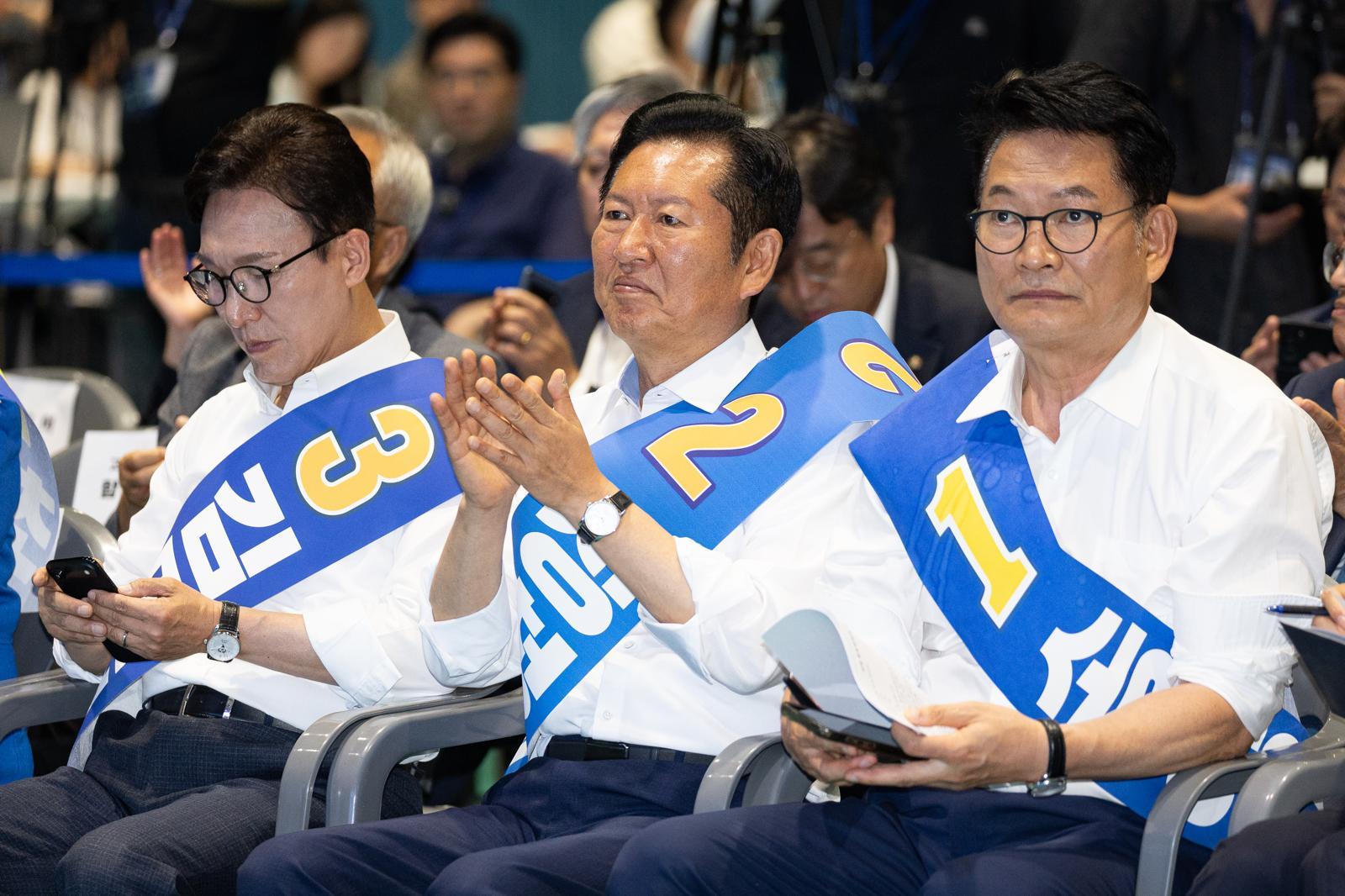
The upcoming August 17th Democratic Party national convention is heating up, with the results of national opinion polls, which account for 30% of the final vote, becoming a focal point for the leading candidates. The race for party leadership is currently a tight contest between Jeong Cheong-rae and Kim Min-seok, though both camps are projecting confidence.
It's lacking by 0.2%. Party members, please hold the hand of Jeong Cheong-rae, the trustworthy and loyal man.
The party's leadership election rules stipulate that 70% of the final score will come from votes cast by delegates and party members, with the remaining 30% determined by national opinion polls. These polls are scheduled to be conducted on August 14th and 15th by two separate firms, surveying 2,000 individuals each using the Random Digit Dialing (RDD) method. To prevent strategic voting, the polls will target both Democratic Party supporters and unaffiliated voters, employing a preferential voting system similar to that used for delegates and party members.
Recent polling data presents a close race. A survey conducted by Realmeter from August 9th to 10th among 1,053 individuals who identify as Democratic Party supporters or are unaffiliated showed Kim Min-seok leading with 46.8%, followed by Jeong Cheong-rae at 35.2%, and Song Young-gil at 6.5%. However, a separate poll commissioned by Newsis and conducted by Ace Research presented a near tie between Kim (36.9%) and Jeong (36.7%) among 646 respondents from the same demographic. Song Young-gil trailed with 7.5% in this survey.
In surveys targeting Democratic Party supporters and unaffiliated voters, there were no results where Kim trailed. Given the inclusion of anti-reverse selection provisions, Kim will likely have the advantage.
Despite the close numbers, both campaigns are projecting optimism. A source close to Kim Min-seok's campaign stated that Kim has consistently led in polls targeting Democratic Party supporters and unaffiliated voters, suggesting he will have an advantage due to the anti-reverse selection measures. Conversely, a representative for Jeong Cheong-rae's campaign predicted Jeong would lead by 3-4 percentage points, believing the national poll results would align with public sentiment in the Seoul metropolitan area.
Jeong will lead by 3 to 4 percentage points. We believe the national opinion poll results will be similar to the sentiment in the Seoul metropolitan area.
DistantNews Editorial
Originally published by Hankyoreh in Korean. Translated, summarized, and contextualized by our editorial team with added local perspective. Read our editorial standards.
More Stories

From Our Blog

What Gets Lost (and Found) When News Is Translated

The Critical Role of Diaspora Media in Global News

What Travellers Should Know About Countries with Restricted Press

A Digital Nomad's Guide to Following Local News

How the Same Story Looks Different in Different Countries
