


SpaceX rocket expected to crash into Moon tomorrow
Translated from Spanish, summarized and contextualized by DistantNews.
At a glance
News
From a news agency
Ongoing story
- The upper stage of a SpaceX Falcon 9 rocket is expected to crash into the Moon on Wednesday.
- The collision will create a new crater but poses no risk to Earth.
- Scientists anticipate observing the debris trail and impact site for scientific study.
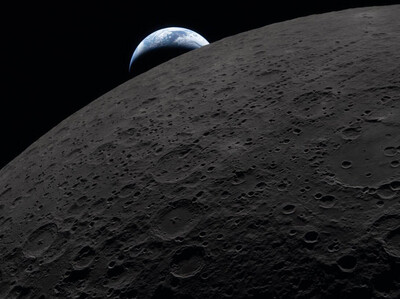
The upper stage of a SpaceX Falcon 9 rocket is on an unintended collision course with the Moon, with impact expected on Wednesday. While the event poses no threat to Earth, it is anticipated to leave a small crater on the lunar surface.
It is not clear how bright it will be, and that is one of the reasons why we want to study this event.
Scientists and space enthusiasts are preparing to observe the aftermath of the impact, which is predicted to occur around 06:35 GMT. Benjamin Fernando of Los Alamos National Laboratory, lead author of a recent study on the event, noted that observers with telescopes might be able to see the plume of material ejected by the impact. "It is not clear how bright it will be, and that is one of the reasons why we want to study this event," Fernando stated.
Assuming all propellant has been expended, the rocket stage weighs approximately 4,000 kilograms. It is expected to strike the Moon's northern hemisphere near the Einstein crater at a speed of about 8,690 kilometers per hour. NASA spokesperson Jimi Russell confirmed that there is "no danger to Earth." NASA plans to track the booster for training purposes and later observe the impact site for scientific data collection.
There is no danger to Earth.
The Falcon 9 rocket launched in January of the previous year, carrying two lunar landers. While the booster returned to Earth, the upper stage remained in space to propel the landers. SpaceX typically performs maneuvers to ensure the safety of its second stages after high-energy missions, according to Julianna Scheiman, a program director at SpaceX. The upcoming lunar impact is a rare artificial collision; NASA previously conducted deliberate impacts during its Apollo program in the 1970s to gather seismic data. Understanding such events is becoming increasingly important as NASA aims to establish a sustained human presence on the Moon.
NASA will continue to track the booster for training purposes and later observe the impact site for scientific purposes.
DistantNews Editorial
Originally published by Diario Libre in Spanish. Translated, summarized, and contextualized by our editorial team with added local perspective. Read our editorial standards.
More Stories



From Our Blog

What Gets Lost (and Found) When News Is Translated

The Critical Role of Diaspora Media in Global News

What Travellers Should Know About Countries with Restricted Press

A Digital Nomad's Guide to Following Local News

How the Same Story Looks Different in Different Countries
