


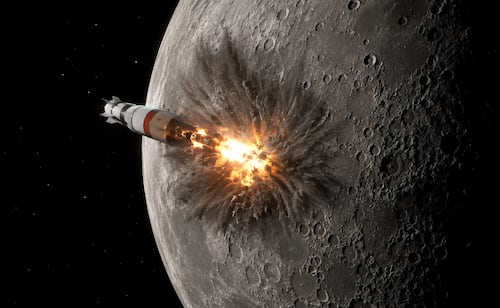
SpaceX rocket stage to impact Moon, creating new crater
Translated from Spanish, summarized and contextualized by DistantNews.
At a glance
News
Sources not specified
Outcome reported
- The upper stage of a SpaceX Falcon 9 rocket will impact the Moon on August 5, over 1.5 years after its launch.
- Scientists will study the impact, which will create a new crater, as all parameters of the collision are known.
- The rocket stage was launched in January 2025 for a NASA program and, lacking sufficient fuel, was left adrift until lunar gravity captured it.
The upper stage of a SpaceX Falcon 9 rocket, owned by Elon Musk's company, is set to collide with the Moon's surface early Wednesday, August 5. The object has been drifting in space for over 18 months since its launch.
Scientists are anticipating the impact, which poses no risk to Earth, as it offers a unique opportunity to study a celestial collision with precisely known parameters. The rocket stage is traveling at approximately 8,700 kilometers per hour. While the exact moment of impact may be difficult to observe from Earth, the collision will create a new crater that can be analyzed by lunar-orbiting probes.
The Falcon 9 upper stage was launched in January 2025 to deliver two commercial payloads, Blue Ghost from Firefly Aerospace and Resilience from Japan's Ispace, to a lunar trajectory. After completing its mission, the rocket stage lacked enough fuel for a return to Earth or trajectory alteration, leading to its uncontrolled drift until lunar gravity intervened.
This event, part of NASA's Commercial Lunar Payload Services (CLPS) initiative aimed at strengthening lunar exploration and preparing for sustained human presence, differs from natural meteorite impacts. Researchers have precise data on the object's mass, velocity, trajectory, and impact angle, identified in orbital records as 2025-010D. This information will allow for comparisons with scientific models to better understand lunar crater formation.
The impact is scheduled for 00:35 Mexico time on Wednesday. Optimal viewing conditions for observing the phenomenon are expected in South America and mid-latitudes of North America, where darkness will aid observation.
DistantNews Editorial
Originally published by El Universal in Spanish. Translated, summarized, and contextualized by our editorial team with added local perspective. Read our editorial standards.
More Stories



From Our Blog

What Press Freedom Means for the News You Read

What Gets Lost (and Found) When News Is Translated

The Critical Role of Diaspora Media in Global News

What Travellers Should Know About Countries with Restricted Press

A Digital Nomad's Guide to Following Local News
