


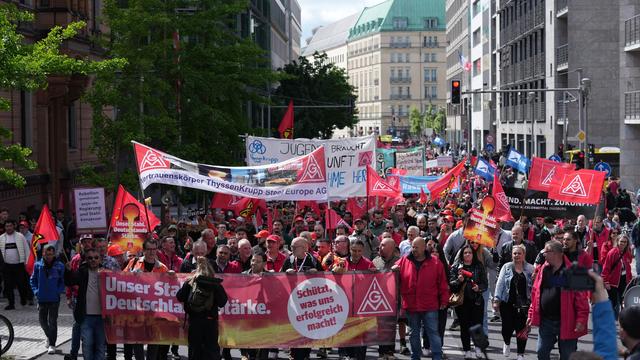
Steel industry in crisis: Fears for jobs drive thousands of steelworkers to the streets
Translated from German, summarized and contextualized by DistantNews.
At a glance
News
From a news agency
Context piece
- Thousands of steelworkers protested in Berlin and Völklingen, Germany, against the industry's crisis and for job security.
- The IG Metall union demands political support, citing economic downturn, cheap Asian steel, high US tariffs, and expensive energy as major challenges.
- Protesters also voiced concerns that proposed climate policy changes could jeopardize the industry's transition to greener steel production.
Thousands of steelworkers took to the streets in Berlin and Völklingen, Germany, to protest the deepening crisis in the steel industry and to demand the preservation of their jobs. Under the slogan "Steel has a future – with us!", workers marched in Berlin, with the IG Metall union reporting around 1,700 participants from over 40 companies, though police estimated the crowd at 900. In Völklingen, Saarland, approximately 8,500 people participated in demonstrations.
Steel has a future – with us!
The IG Metall union is calling for increased political assistance for the struggling sector. The industry faces a confluence of challenges, including a general economic downturn, reduced demand from customer sectors like automotive manufacturing, high energy costs, and intense competition from low-cost steel, particularly from Asia. Additionally, significant U.S. tariffs on steel imports are impacting German producers.
Beyond immediate economic pressures, the protests also highlighted concerns about the future of steel production. Companies like Salzgitter and Saarstahl have initiated steps toward transforming their operations for "green steel" production, which involves lower carbon emissions. However, ArcelorMittal halted plans for climate-neutral upgrades at its German plants in 2025. The transition to green steel requires substantial investment in new facilities that utilize natural gas and later hydrogen, but the market for these products is still nascent.
We want to produce green steel, our steelworks will be climate-neutral as far as possible. But politics must consistently create the possibility for this.
Jürgen Kerner, the union's second chairman, emphasized the need for political action to facilitate this green transition. "We want to produce green steel, our steelworks will be climate-neutral as far as possible," Kerner stated. "But politics must consistently create the possibility for this." He warned that weakening European climate regulations, such as the Emissions Trading System (ETS), could put tens of thousands of jobs at risk and potentially lead to a "rollback" on climate protection efforts, a concern echoed by Saarland's state premier Anke Rehlinger.
The challenges of the steel industry remain huge and the ETS trade is only the tip of the iceberg here.
DistantNews Editorial
Originally published by Die Zeit in German. Translated, summarized, and contextualized by our editorial team with added local perspective. Read our editorial standards.
More Stories

From Our Blog

What Gets Lost (and Found) When News Is Translated

How the Same Story Looks Different in Different Countries

The Critical Role of Diaspora Media in Global News

What Travellers Should Know About Countries with Restricted Press

A Digital Nomad's Guide to Following Local News
