


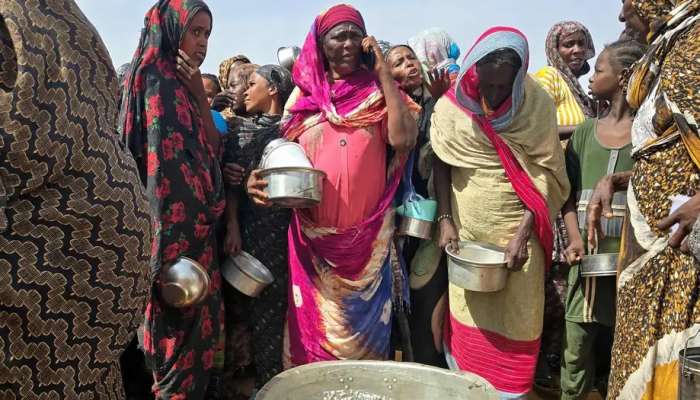
Sudan civil war: Civilians used as 'human shields' in El Obeid
Translated from English, summarized and contextualized by DistantNews.
At a glance
News
Named sources
Ongoing story
- Civilians in El Obeid, Sudan, are reportedly being used as 'human shields' amid the ongoing civil war.
- Paramilitary Rapid Support Forces (RSF) drone attacks have caused extensive damage to civilian infrastructure, including schools and hospitals.
- The city faces severe shortages of essential supplies, and residents live in constant fear of further attacks.
Scenes of devastation in El Obeid, Sudan, reveal flattened houses and rubble where schools once stood, according to footage published by the Ayin Network. Drone attacks by the paramilitary Rapid Support Forces (RSF) have inflicted immense damage on civilian infrastructure, crippling power grids, water treatment plants, schools, universities, and hospitals in the capital of North Kordofan.
Ahmed Awad, project manager for the UK children's rights organization Plan International and a native of El Obeid, described the dire situation for the city's population, which has swelled with internally displaced persons (IDPs). El Obeid, previously home to half a million people, is now under siege, facing critical shortages of medical supplies, food, and safe drinking water. Awad recounted witnessing long queues at a single water pump, where residents might spend an entire day to obtain just one liter of water for several days' use.
The psychological toll on children is profound. A drone strike on a primary school resulted in the deaths of three children, leaving others traumatized and fearful of attending school. "One of the mothers said three of her children cannot sleep because always they are in fear of something happening again," Awad stated, noting Plan International's efforts to provide psychosocial support to those living under the constant threat of aerial attacks.
Sometimes you can spend all day to get one liter of water for two or three days.
El Obeid's strategic importance as a desert trading hub on the route between Khartoum and Darfur has made it a frequent battleground. The city has changed hands multiple times between the Sudanese Armed Forces (SAF) and the RSF since the war began in 2023. Currently controlled by the army, El Obeid remains on the front lines, with RSF forces positioned just outside the city limits, continuing their drone bombardments of civilian infrastructure.
Analysts, aid organizations, and the United Nations have issued warnings about the potential for the RSF to capture El Obeid, drawing parallels to the atrocities witnessed in El Fasher. A UN Fact-Finding Mission identified "hallmarks of genocide" in the capture of El Fasher, raising grave concerns that a similar scenario could unfold in El Obeid if the situation escalates. Human rights organizations have issued a joint appeal, cautioning against a repeat of such atrocities.
One of the mothers said three of her children cannot sleep because always they are in fear of something happening again.
DistantNews Editorial
Originally published by Times of Oman in English. Translated, summarized, and contextualized by our editorial team with added local perspective. Read our editorial standards.
More Stories
From Our Blog

What Gets Lost (and Found) When News Is Translated

The Critical Role of Diaspora Media in Global News

What Travellers Should Know About Countries with Restricted Press

A Digital Nomad's Guide to Following Local News

How the Same Story Looks Different in Different Countries
