


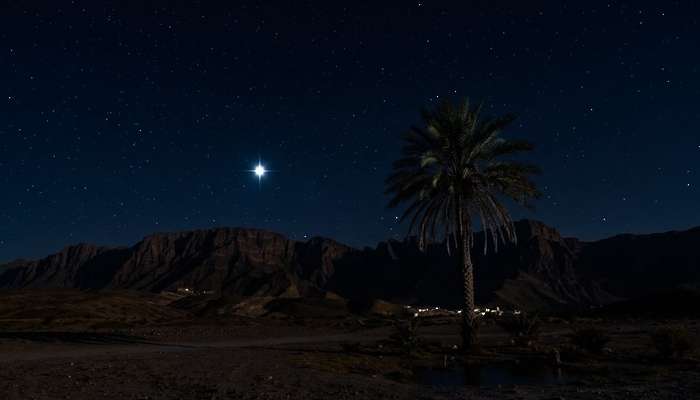
Suhail star heralds seasonal changes in Oman
Summarized and contextualized by DistantNews.
At a glance
News
Sources not specified
Context piece
- The star Suhail (Canopus) has appeared in Oman's skies in late August, traditionally signaling the end of intense summer heat.
- Suhail's appearance is a significant marker in Oman's traditional astronomical knowledge, influencing agricultural and maritime activities.
- The star's return offers a chance to blend modern astronomy with Oman's rich heritage, preserving traditional knowledge for future generations.
As the intense Omani summer begins to wane, stargazers are looking to the southeastern horizon for the annual appearance of the star Suhail, also known as Canopus. This celestial event, occurring in the latter half of August, traditionally signals a gradual shift towards cooler seasons.
Suhail is located about 313 light-years from Earth and is the second-brightest star in the night sky.
Wisal bint Salem Al-Hinai, head of the Community Outreach Committee at the Omani Society for Astronomy and Space, explained that Suhail, located about 313 light-years away, is the second-brightest star in the night sky and has a distinct yellowish-white hue. While its appearance doesn't directly alter weather patterns, it has long been a crucial marker in Oman's traditional astronomical calendar.
while the appearance of Suhail does not directly cause changes in temperature or weather, it has long served as an important seasonal marker in Oman’s traditional astronomical knowledge.
Historically, the "Suhail calculation" guided seasonal changes, aiding in the organization of agricultural and maritime endeavors. Omani sailors and captains also depended on celestial navigation for their voyages. Astronomical observations were integral to traditional irrigation systems, with star movements dictating water share regulations in the aflaj and adjustments to irrigation schedules under systems like athar and badah.
The traditional “Suhail calculation” was used to identify seasonal changes and help organise agricultural and maritime activities.
Suhail is woven into Oman's cultural fabric through proverbs that encapsulate generations of experience observing seasonal shifts. Al-Hinai noted that the star first becomes visible before sunrise, low in the southeast, before ascending higher. She views Suhail's annual return as a valuable opportunity to connect modern astronomical science with Oman's deep-rooted heritage, fostering the preservation and documentation of this ancient knowledge for posterity.
Suhail has also become part of Oman’s popular cultural memory through traditional proverbs reflecting generations of local experience in observing seasonal changes.
DistantNews Editorial
Originally published by Times of Oman. Summarized and contextualized by our editorial team with added local perspective. Read our editorial standards.
More Stories



From Our Blog

What Gets Lost (and Found) When News Is Translated

The Critical Role of Diaspora Media in Global News

What Travellers Should Know About Countries with Restricted Press

A Digital Nomad's Guide to Following Local News

How the Same Story Looks Different in Different Countries
