


Support Nepal’s Recovery
Translated from English and summarized by DistantNews. Read the original for the full story.
At a glance
Opinion
Named sources
Ongoing story
- Flooding along Nepal’s Bhotekoshi-Trishuli corridor affected an estimated 1.6 million people and destroyed or damaged thousands of buildings and critical infrastructure.
- The disaster damaged bridges, roads, schools, health posts, hydropower projects and communications, with losses likely to reach several billion dollars.
- The government has begun work to restore connectivity, but the scale of the recovery will require substantial national and international donor support.
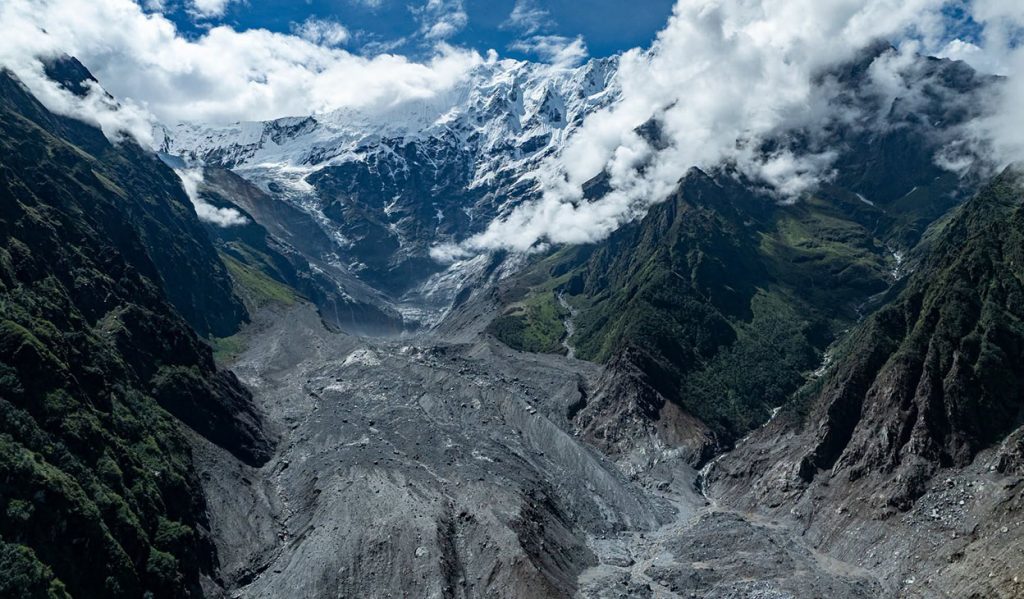
The damage from the August 26 flooding along Nepal’s Bhotekoshi-Trishuli river corridor is immense. Roads, schools, health posts and private homes disappeared within minutes, along with the lives of hundreds of people.
An assessment by the National Disaster Risk Reduction and Management Authority estimates that about 1.6 million people have been affected. Satellite mapping has identified 4,689 buildings in the affected zone. Forty-one motorable bridges were swept away and another four damaged. Forty kilometres of roads linking the area to the northern border were completely washed away.
Nineteen schools serving 6,901 students were destroyed or damaged. Four health posts were destroyed and two others partially damaged. The floods also damaged 12 hydropower projects, including facilities that were operating and others still under construction. Communications services were disrupted, while the eventual bill is expected to run into several billion dollars.
Search and rescue efforts are continuing alongside the task of restoring basic connectivity. Addressing the House of Representatives, Prime Minister Balendra Shah said work had begun on three Bailey bridges and feasibility studies were underway for 20 more. He also said every affected person would receive care during recovery and rehabilitation.
That promise requires resources Nepal does not have on its own. The country relies heavily on domestic and foreign borrowing to finance development, making appeals to national and international donors unavoidable. More than Rs7 billion, as well as $6 million in dollar accounts, has reached the Prime Minister’s Relief Fund in just over a week. Yet the money remains far short of what is needed. Former National Planning Commission vice-chair Govind Raj Pokharel has estimated that rehabilitation could cost several times more than the $6 billion spent on post-earthquake reconstruction. Unlike many earthquake victims, flood survivors may not even have land on which to rebuild, potentially forcing entire settlements to relocate and highways to be realigned.
Every individual would be catered for and everyone would be taken care of during recovery and rehabilitation.
About this summary
Originally published by Kathmandu Post in English. Translated, summarized, and contextualized automatically by DistantNews, with a note on how the source frames the story. Not individually reviewed before publishing. How this works.
More Stories


From Our Blog

News in Translation: What Gets Lost, and How We Keep the Framing

Diaspora Media: How Communities Abroad Follow Home

Traveling Where the Press Is Not Free: How to Read the News There

The Digital Nomad's Guide to Local News

The Same Story, Different Countries: How Coverage Changes at the Border
