


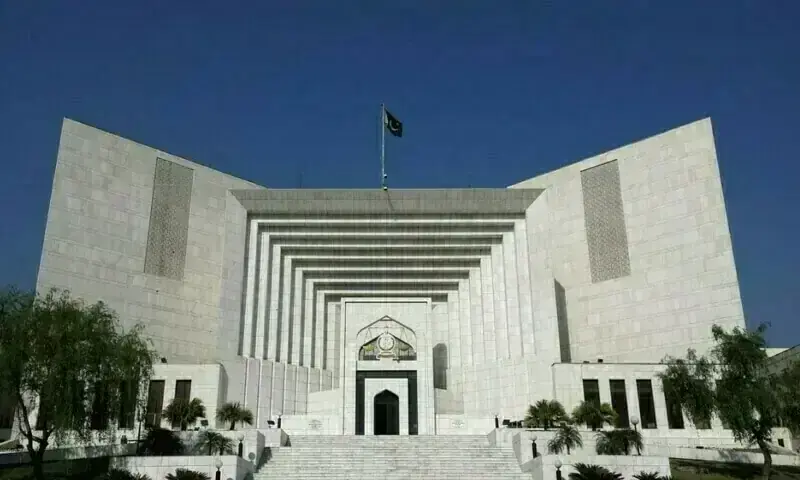
Supreme Court cautions courts on property disputes amid soaring prices
Summarized and contextualized by DistantNews.
At a glance
News
Named sources
Outcome reported
- The Supreme Court of Pakistan cautioned lower courts to consider current economic realities when adjudicating property disputes, noting rapid price increases.
- The court upheld a decision denying a buyer specific performance after they failed to pay the balance sale amount within the agreed timeframe.
- The ruling emphasizes that buyers must be ready and willing to fulfill their contractual obligations, including timely payment, to seek equitable remedies.
Pakistan's Supreme Court has urged lower courts to interpret property agreements with a keen eye on today's soaring real estate values, a stark contrast to past decades of slow appreciation. Justice Miangul Hassan Aurangzeb highlighted in a judgment that current economic realities must guide decisions in property disputes.
Therefore, while dealing with property disputes, courts must interpret agreements concerning property in light of current economic realities.
This guidance came as the court considered a civil appeal, ultimately upholding a Lahore High Court decision from March 4, 2020. The lower court had rejected a suit for specific performance filed by Amjad Javed, a purchaser from Sialkot, against property seller Maqsood Ahmad. A two-judge bench dismissed Javed's appeal, reinforcing the principle that a buyer who misses a payment deadline forfeits the right to demand specific performance of the agreement.
The case involved a property in Sialkot, where Javed had paid Rs800,000 as earnest money for a property valued at Rs7.28 million. The agreement, dated March 11, 2014, stipulated the remaining Rs6.48 million was due by July 27, 2014, with a clause for forfeiture of the earnest money upon failure to meet this deadline. The Supreme Court noted that Javed did not deposit the balance amount even after being granted two opportunities, leading the trial court to dismiss his request for an extension and subsequently his suit for specific performance on January 20, 2015.
If a plaintiff does not deposit the balance sale consideration within the time stipulated by the trial court, the presumption would be that the plaintiff was not serious in prosecuting his remedy.
Justice Aurangzeb stressed that plaintiffs seeking specific performance must demonstrate consistent readiness and willingness to fulfill their contractual duties. "If a plaintiff does not deposit the balance sale consideration within the time stipulated by the trial court, the presumption would be that the plaintiff was not serious in prosecuting his remedy," he stated. The judgment also referenced the requirements under Forms 47 and 48 of the Code of Civil Procedure, which mandate that parties plead their continued readiness and willingness to perform their parts of the agreement.
Although the petitioner has pleaded that he is ready and able
DistantNews Editorial
Originally published by Dawn. Summarized and contextualized by our editorial team with added local perspective. Read our editorial standards.
More Stories


From Our Blog

What Gets Lost (and Found) When News Is Translated

The Critical Role of Diaspora Media in Global News

What Travellers Should Know About Countries with Restricted Press

A Digital Nomad's Guide to Following Local News

How the Same Story Looks Different in Different Countries
