


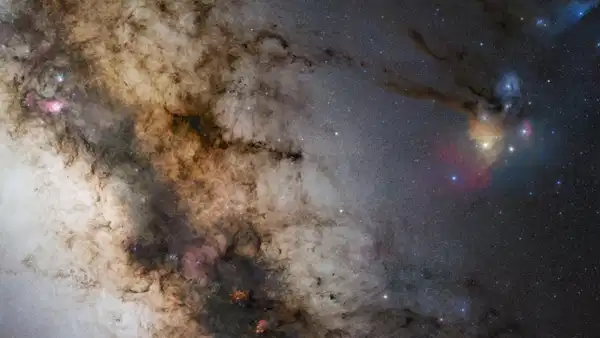
Surprising discovery in interstellar space: Sugar found 26,700 light-years away
Translated from Turkish, summarized and contextualized by DistantNews.
At a glance
News
Named sources
Context piece
- Researchers detected the molecule erythrulose, a type of sugar, in a molecular cloud 26,700 light-years away.
- Erythrulose can contribute to the formation of RNA and DNA building blocks when in contact with water, suggesting organic compounds essential for life may form in interstellar space.
- This discovery fills a gap in understanding the chemical origins of life, as no sugar molecule had previously been found in the interstellar medium.
In a significant astronomical discovery, scientists have detected a sugar molecule, erythrulose, in the interstellar space for the first time. The molecule was identified within the G+0.693-0.027 molecular cloud, located approximately 26,700 light-years from Earth, in the direction of the Milky Way's center.
The research, led by the Center for Astrobiology in Spain, utilized observations from the Yebes 40-meter and IRAM 30-meter radio telescopes. The detection of 17 spectral signatures of erythrulose within this distant cloud offers crucial insights into the chemical processes that may have seeded life on Earth.
Scientists highlight that erythrulose plays a role in forming the building blocks of RNA and DNA when it interacts with water. This finding strengthens the hypothesis that essential organic compounds for life could have been synthesized in interstellar space before the formation of our solar system. Researchers suggest these molecules might have been transported to the early Earth via comets, asteroids, and meteorites.
Calculations indicate that between 500 million and 50 billion kilograms of erythrulose could have reached Earth during the early solar system's period of heavy bombardment. While not a definitive conclusion, this aligns with models exploring the chemical origins of life. The discovery fills a significant gap, as previous interstellar findings included sugar precursors or sugar-like organic compounds, but never an actual sugar molecule.
DistantNews Editorial
Originally published by Cumhuriyet in Turkish. Translated, summarized, and contextualized by our editorial team with added local perspective. Read our editorial standards.
More Stories


From Our Blog

What Gets Lost (and Found) When News Is Translated

The Critical Role of Diaspora Media in Global News

What Travellers Should Know About Countries with Restricted Press

A Digital Nomad's Guide to Following Local News

How the Same Story Looks Different in Different Countries
