


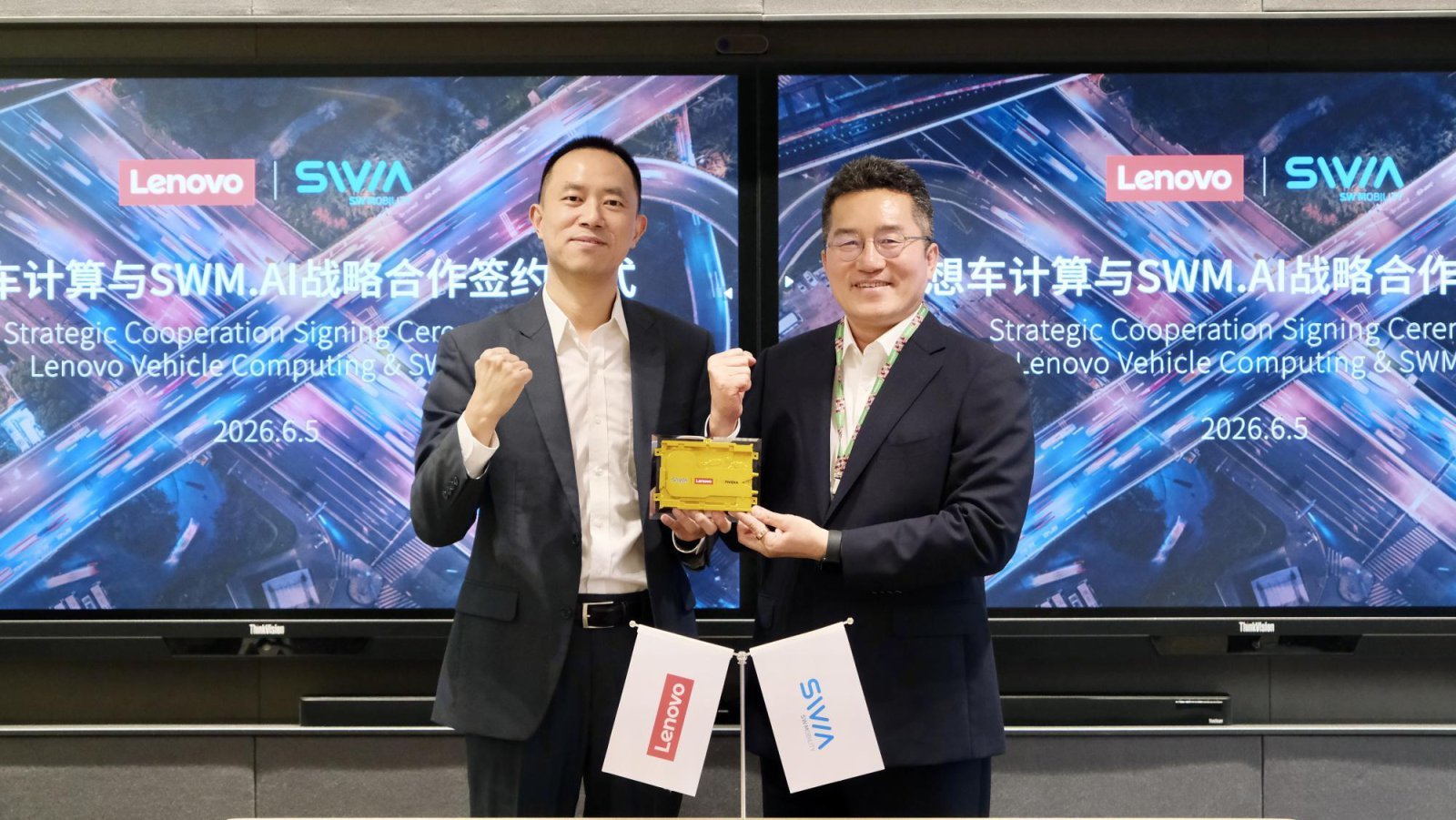
SWM.AI and Lenovo to jointly develop next-gen autonomous driving controller
Translated from Korean, summarized and contextualized by DistantNews.
At a glance
News
Named sources
New plan
- SWM.AI and Lenovo have signed a contract to jointly develop the next-generation autonomous driving controller, the 'AP-700'.
- The collaboration aims to create a complete physical AI for fully driverless autonomous vehicles by combining real-world driving data from Seoul with global computing technology.
- SWM.AI's robo-taxi service, operating in Seoul's Gangnam district since September 2024, has accumulated significant real-world driving data crucial for advancing AI models.
South Korean AI company SWM.AI is partnering with global tech giant Lenovo to develop a cutting-edge autonomous driving controller, the 'AP-700'. This collaboration aims to accelerate the realization of fully driverless vehicles by integrating SWM.AI's extensive real-world driving data from Seoul with Lenovo's advanced computing capabilities.
The project focuses on creating a 'Physical AI' – systems that can perceive, reason, and act in the real world. SWM.AI's robo-taxi service, which has been navigating the complex urban environment of Seoul's Gangnam district since September 2024, provides invaluable data. This data, gathered from challenging conditions like high traffic density and unexpected events, is essential for refining AI models.
Every robo-taxi running on the same roads as citizens every day is the first Physical AI to enter our daily lives. Combining the real-world driving data accumulated in the Gangnam city center with the in-vehicle AI computing platform will accelerate the commercialization of fully driverless autonomous driving.
This partnership is seen as a critical step towards commercializing fully autonomous driving. The 'AP-700' controller will be equipped with dual NVIDIA Drive Thor-X SoCs for real-time processing of sensor data and AI computations, alongside Infineon TC397 MCUs for enhanced safety and reliability. The system will also feature a liquid cooling system to maintain stable performance under heavy computational loads, ensuring the dependability required for driverless robo-taxi services.
SWM.AI CEO Kim Ki-hyuk emphasized that robo-taxis, operating daily alongside citizens, represent the most immediate application of Physical AI. He believes the combination of Gangnam's real-world data and the new AI computing platform will significantly advance the commercialization of fully driverless technology. This collaboration is framed not just as controller development, but as the construction of a complete Physical AI system ready for real-world deployment, with ambitions to compete in the global Physical AI and autonomous driving markets.
This collaboration is not simply about developing a controller, but about building a complete Physical AI that operates in the real world. Based on technology verified in actual urban environments, we will continue to respond technologically in the global Physical AI and autonomous driving market.
DistantNews Editorial
Originally published by Dong-A Ilbo in Korean. Translated, summarized, and contextualized by our editorial team with added local perspective. Read our editorial standards.
More Stories

From Our Blog

What Gets Lost (and Found) When News Is Translated

The Critical Role of Diaspora Media in Global News

What Travellers Should Know About Countries with Restricted Press

A Digital Nomad's Guide to Following Local News

How the Same Story Looks Different in Different Countries
