

Taibo II admits "reinformation" campaign against "pinche media"
Translated from Spanish, summarized and contextualized by DistantNews.
At a glance
News
Named sources
Context piece
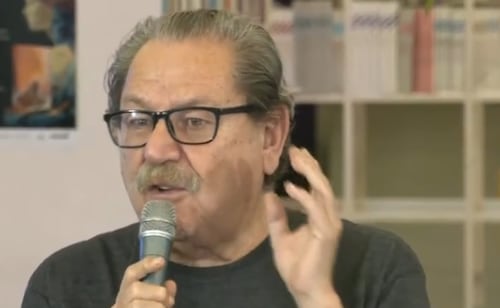
- Paco Ignacio Taibo II, director of Mexico's Economic Culture Fund (FCE), acknowledged a "reinformation" campaign against critical media.
- He defended his use of the word "pinche" (a vulgar Mexican Spanish term) to describe media outlets he deems low-quality or hostile.
- Taibo II stated that FCE bookstores are not disappearing but will expand, countering reports of their absorption by the FCE.
Paco Ignacio Taibo II, the head of Mexico's Economic Culture Fund (FCE), has openly declared a "reinformation" campaign against what he calls "pinche" media outlets. This campaign is a direct response to a report published by EL UNIVERSAL on August 3rd, titled "En extinción, librerías de Educal," which detailed the FCE's absorption of branches from the Educal bookstore chain.
I had to use rude words, taking shelter in the dictionary of Spanish spoken in Mexico, and I said: 'Listen, young people, this obeys a type of pinche media, and I used the word pinche relying on the definition, which I love'.
Taibo II defended his use of the word "pinche," a highly colloquial and often vulgar term in Mexican Spanish, by citing dictionary definitions. He explained to interviewer Julio Astillero that he used the word "pinche" to convey strong emotion or anger, and that it can describe something or someone of low quality, mean, annoying, or worthless. He acknowledged his tendency to speak his mind, even if it leads to bluntness, but insisted his criticism of the media was justified.
'Pinche is a word that serves to give force or anger to a daily situation, without necessarily being a direct insult.' And furthermore, it is used 'to describe something or someone of low quality, mean, annoying, or worthless'.
Astillero, in turn, questioned the extent to which the press acts as a "pinche" for the right-wing and far-right, seeking to regain power. Taibo II appreciated this "reinterpretation" and downplayed the significance of the initial report, asserting that the FCE's bookstores are not only surviving but will grow. He projected an increase from 100 to 103 bookstores, with new locations planned in Reynosa, Córdoba, Ecatepec, and a museum in Mexico City, alongside improvements to existing branches.
I know I have a long tongue sometimes and that I sin by saying what I think and not by thinking what I say, but in this case it was fully justified.
In further efforts to "reinform" the public through official channels, Taibo II appeared on the Canal 14 program "Leer: una hora inesperada." There, he reiterated his criticism, labeling the FCE as a recipient of "a wave of pinche critical thinking," which he associates with "poverty" and "weakness of thought." He specifically targeted what he called the "conservative press of Mexico City" for an "offensive" that labeled the FCE as "destroyers." Taibo II asserted that the bookstores would not only survive but expand, emerging from a "permanent crisis" created by Educal.
What extent does this press act as a pinche for the right-wing and far-right that wish to return to power? What extent is the auxiliary service they provide?
DistantNews Editorial
Originally published by El Universal in Spanish. Translated, summarized, and contextualized by our editorial team with added local perspective. Read our editorial standards.
More Stories


From Our Blog

What Press Freedom Means for the News You Read

What Gets Lost (and Found) When News Is Translated

The Critical Role of Diaspora Media in Global News

What Travellers Should Know About Countries with Restricted Press

A Digital Nomad's Guide to Following Local News
