


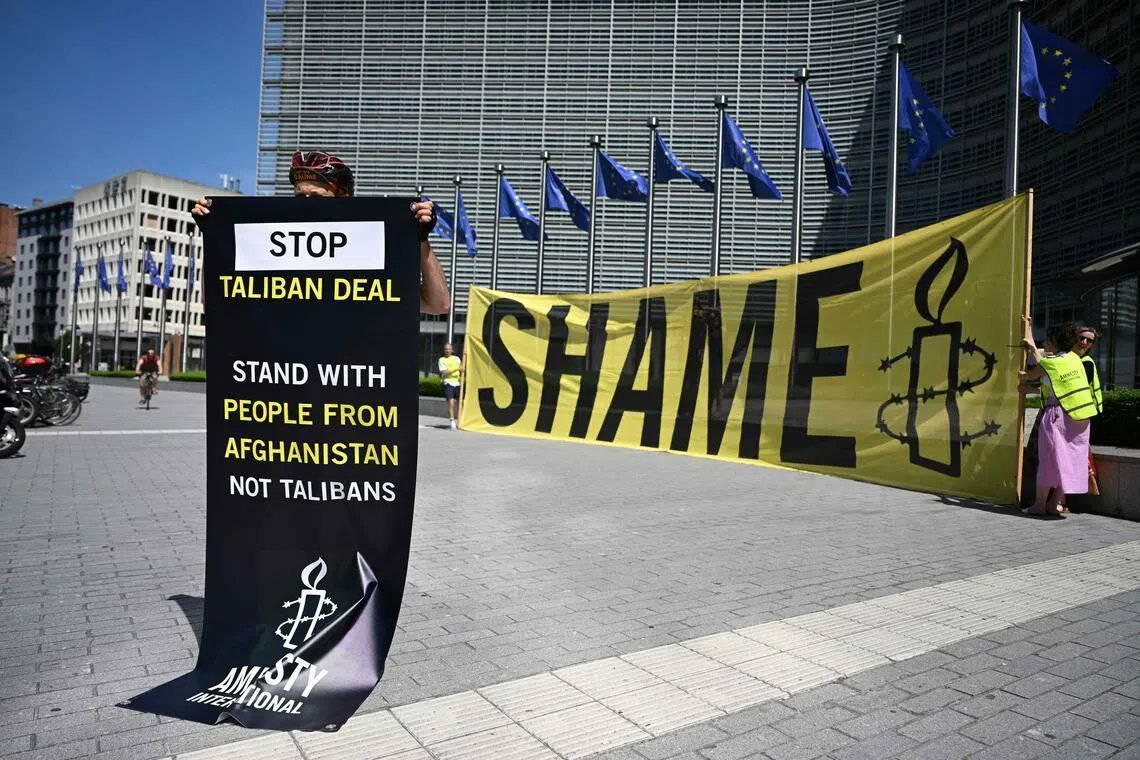
Taliban Delegation Meets EU in Brussels; Rights Groups Protest
Translated from Turkish, summarized and contextualized by DistantNews.
At a glance
News
Named sources
Context piece
- A Taliban delegation met with EU officials in Brussels for the first time since the group retook power in Afghanistan.
- The EU, which does not officially recognize the Taliban, stated the talks were necessary for the return and readmission of Afghan citizens denied asylum in the EU.
- Human rights groups and some politicians criticized the meeting, fearing it could legitimize the Taliban and overshadow human rights abuses.
A Taliban delegation convened with European Union officials in Brussels for the first time since the group seized control of Afghanistan, marking a significant diplomatic engagement. While the EU and its member states do not formally recognize the Taliban administration, Brussels maintains that limited contact with Afghanistan's "de facto authorities" is essential for managing the return and readmission of Afghan nationals whose asylum claims have been rejected.
The meeting was co-chaired at a technical level with Sweden, and it is a continuation of the previous meeting held in Kabul in January.
European Commission Spokesperson confirmed that Commission officials and representatives from 15 EU member states participated in the technical-level meeting. The discussions focused on the return and readmission of Afghan citizens without the right to remain in the EU. This meeting follows a previous encounter in Kabul in January, co-chaired by Sweden.
The Taliban's Foreign Ministry Spokesperson, Abdul Qahar Balkhi, indicated that the agenda was broader, including potential consular presence in the EU, the resumption of consular services for Afghans in Europe, and confidence-building measures. Balkhi suggested the talks could create "positive momentum" for protecting the consular rights of Afghans living abroad.
The meeting could create 'positive momentum' in terms of protecting the consular rights of Afghans living abroad.
However, the meeting drew sharp criticism from human rights organizations and some European politicians. Critics argue that engaging with the Taliban at this level risks legitimizing the administration and downplaying the severe human rights violations occurring in Afghanistan. Nobel Peace Prize laureate Malala Yousafzai stated on social media that Europe should not legitimize a regime responsible for one of the world's most severe human rights crises.
Europe should not legitimize a regime responsible for one of the world's most severe human rights crises.
Concerns were particularly raised about the potential risks faced by individuals returned to Afghanistan under Taliban rule, including the possibility of persecution. Jeff Crisp, former head of policy and evaluation at UNHCR and visiting research fellow at Oxford University, warned that the most dangerous outcome could be the forced return of Afghans, who might then face repression upon arrival.
The most dangerous outcome of the contacts with the Taliban could be the return of Afghans to Afghanistan.
DistantNews Editorial
Originally published by Cumhuriyet in Turkish. Translated, summarized, and contextualized by our editorial team with added local perspective. Read our editorial standards.
More Stories


From Our Blog

What Gets Lost (and Found) When News Is Translated

The Critical Role of Diaspora Media in Global News

What Travellers Should Know About Countries with Restricted Press

A Digital Nomad's Guide to Following Local News

How the Same Story Looks Different in Different Countries
