


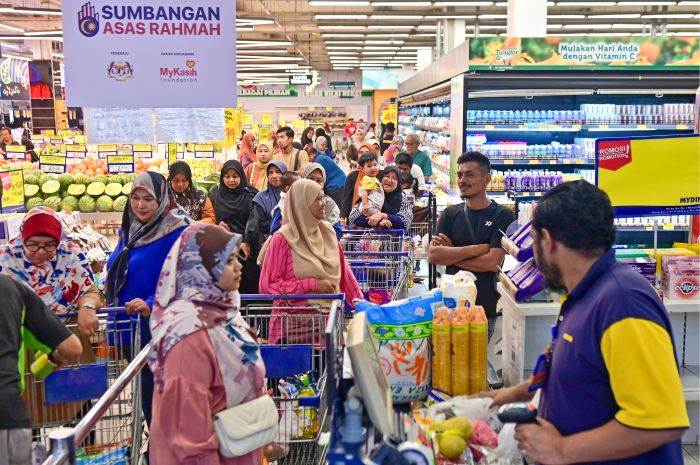
Targeted aid needs to balance household income and expenses
Translated from Malay, summarized and contextualized by DistantNews.
At a glance
Opinion
Named sources
Context piece
- A Malaysian writer argues that targeted aid should consider household expenses, not just income, to better assist those truly in need.
- The current system, focused on income brackets like B40, may overlook families with high expenses despite moderate incomes.
- The author suggests a needs-based approach, where high essential spending relative to income determines eligibility for aid.
Targeted subsidies and aid in Malaysia should be recalibrated to account for household expenses alongside income, argues Noruddin Idris. He contends that the current system, which primarily relies on income thresholds, fails to adequately support families facing significant financial burdens.
A family with eight household members will certainly involve higher household expenses than a family with a husband and wife.
Idris illustrates this point with an example: a family earning RM6,000 monthly with six children and two adults would have a per-person allocation of RM750. In contrast, a smaller family earning RM3,000 with two adults and one child would have a per-person allocation of RM1,000. Logically, the larger family, despite a higher household income, faces greater financial strain.
Which family needs assistance more? Current logic shows that a household with RM3,000 income falls into the B40 category and is more eligible for aid compared to a family with RM6,000 income that bears a larger burden, such as six children plus husband and wife, even though they fall into the M40 category.
The author shares the experience of his nephew, whose household income exceeds RM6,000 but was denied zakat (charitable) aid. The family, with two university students and four younger children in school, has substantial expenses. Their application was rejected because their income fell outside the B40 category, defined as below RM5,250 monthly. This family was forced to dip into their Employees Provident Fund (EPF) savings to manage daily costs.
His application for zakat aid was rejected because he did not fall into the B40 category with an income of less than RM5,250 per month.
Idris advocates for a revised approach where aid eligibility is determined by the ratio of essential household spending to income. Families whose essential expenses exceed their income, regardless of whether they fall into B40, M40, or T20 income categories, are the ones most in need of assistance. He stresses that the goal of targeted aid should be to reach those genuinely requiring support, not solely to adhere to income brackets.
If the government wants to target aid to those truly in need, the target should not be tied solely to household income. It needs to consider basic household expenses against household income.
DistantNews Editorial
Originally published by Utusan Malaysia in Malay. Translated, summarized, and contextualized by our editorial team with added local perspective. Read our editorial standards.
More Stories



From Our Blog

What Gets Lost (and Found) When News Is Translated

The Critical Role of Diaspora Media in Global News

What Travellers Should Know About Countries with Restricted Press

A Digital Nomad's Guide to Following Local News

How the Same Story Looks Different in Different Countries
