

Test shows sheep’s wool could protect glaciers as well as plastic
Translated from German and summarized by DistantNews. Read the original for the full story.
At a glance
News
From a news agency
Ongoing story
- The Summit Foundation covered sections of the Tsanfleuron Glacier in western Switzerland with sheep-wool blankets and synthetic geotextiles for comparison.
- Initial measurements showed both materials reduced melting by 50% to 70%.
- The experiment offers a biodegradable alternative, but coverings protect only a tiny share of Switzerland’s glaciers and cannot halt their overall decline.
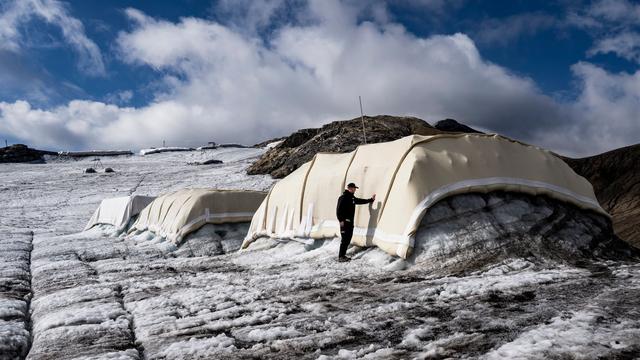
Sheep’s wool has passed an early test as a possible alternative to plastic glacier covers. In June, the environmental group Summit Foundation covered 100 square metres of the Tsanfleuron Glacier in Les Diablerets with different wool blankets and placed synthetic geotextiles over a neighbouring area of the same size.
The experiment, conducted with the participation of the University of Lausanne, was named “Keep it Wool,” a pun on the English phrase “Keep it cool.” Initial measurements showed that the wool reduced glacier melt as effectively as the synthetic coverings, by between 50% and 70%, according to the organisation.
The foundation says wool avoids the risk of synthetic fibres entering the water cycle. It describes the material as natural, renewable and biodegradable, and notes that sheep’s wool often goes unused.
The findings do not offer a way to stop the retreat of the Alps’ glaciers. Coverings are too laborious and expensive to use across large areas. Textiles protect only about 0.02% of Switzerland’s total glacier surface. They preserve roughly 300,000 cubic metres of snow each year, compared with nearly one billion cubic metres lost annually.
Swiss glaciers lost almost 40% of their volume between 2000 and 2024.
About this summary
Originally published by Die Zeit in German. Translated, summarized, and contextualized automatically by DistantNews, with a note on how the source frames the story. Not individually reviewed before publishing. How this works.
More Stories



From Our Blog

What Gets Lost (and Found) When News Is Translated

How the Same Story Looks Different in Different Countries

The Critical Role of Diaspora Media in Global News

What Travellers Should Know About Countries with Restricted Press

A Digital Nomad's Guide to Following Local News
