


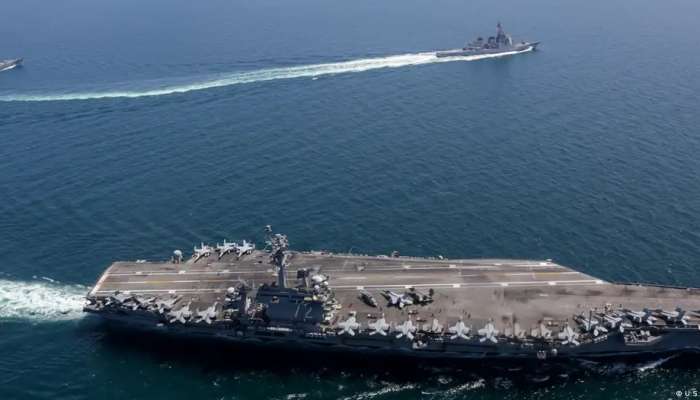
The collapse of 'world order' as an opportunity for Asia?
Summarized and contextualized by DistantNews.
At a glance
Analysis
Named sources
Context piece
- European leaders express shock over Russia's war in Ukraine and perceived U.S. disregard for the international order, signaling the end of the post-WWII world order.
- Asian observers, however, view this shift as less surprising, attributing it to a temporary obscuring of fundamental international relations characteristics like competition and conflict.
- The unipolar era is over, with the U.S. overextended and unlikely to return to its previous global role, leading to a 'wolf world' where power dynamics, rather than law, dictate international relations.
The post-World War II international order appears to be crumbling, marked by Russia's war in Ukraine and perceived U.S. disregard for global norms, according to European observers. Friedrich Merz, German Chancellor, stated at the Munich Security Conference in February 2026 that the order, however imperfect, no longer exists in its previous form. This sentiment reflects a broader consternation among European leaders regarding the current state of global affairs.
This order, as imperfect as it was even in its best days, no longer exists in that form.
In contrast, political observers in Asia view the situation with less surprise. Former Singaporean diplomat Bilahari Kausikan noted during the Shangri-La Dialogue that Europe perhaps believed the world had become more predictable. He suggested that competition and conflict are inherent to international relations, truths that were temporarily obscured for about two decades following the fall of the Berlin Wall until the global financial crisis.
Europe thought the jungle had been tamed for good. And then it got a shock.
Marc Saxer, Asia-Pacific head of Germany's Friedrich-Ebert-Foundation, believes that a return by the U.S. to its pre-2010s global role is structurally impossible. He argues that the unipolar era has concluded as the U.S. has strategically overextended itself across multiple conflict zones. Thomas Kleine-Brockhoff of the German Council on Foreign Relations (DGAP) suggests that the U.S. under Trump might be attempting to establish a hegemonic world order, a 'global directorate' with Russia and China, creating spheres of influence.
Competition and conflict are fundamental characteristics of international relations. These enduring, harsh truths were obscured for a brief period, perhaps about 20 years from the fall of the Berlin Wall to the outbreak of the global financial crisis. This was an extraordinary phase in world history.
This shift undermines international law and institutions like the United Nations, as major powers pursue their own interests. Saxer describes the emerging global landscape as a "wolf world," where the law of the strongest prevails. In response, middle powers are beginning to push back, with countries like Japan, situated near China, seeking to deepen alliances and strategic partnerships in the Asia-Pacific region.
a return by the US to the role it played until the 2010s is impossible for structural reasons.
DistantNews Editorial
Originally published by Times of Oman. Summarized and contextualized by our editorial team with added local perspective. Read our editorial standards.
More Stories


From Our Blog

What Gets Lost (and Found) When News Is Translated

The Critical Role of Diaspora Media in Global News

What Travellers Should Know About Countries with Restricted Press

A Digital Nomad's Guide to Following Local News

How the Same Story Looks Different in Different Countries
